Digital Editions
Newsletters
Subscribe
Digital Editions
Newsletters
Art market
Museums & heritage
Exhibitions
Books
Podcasts
Columns
Art of Luxury
Adventures with Van Gogh
Venice Biennale
Art market
Museums & heritage
Exhibitions
Books
Podcasts
Columns
Art of Luxury
Adventures with Van Gogh
Venice Biennale
Museums
news

‘Rembrandt’s DNA would be the Holy Grail’: new research samples bacteria on the surface of The Night Watch

A installation developed by the Rijksmuseum in Amsterdam and a microbes museum in the city’s zoo will depict microbes found in the Old Master painting

Senay Boztas
11 September 2026
Share
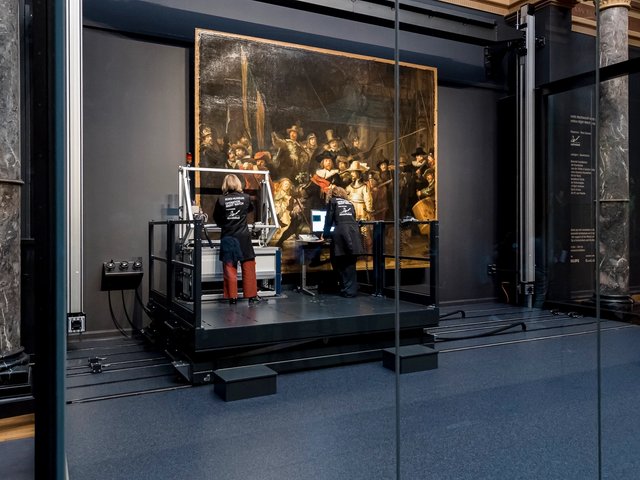
A laboratory technician from ARTIS-Micropia and conservators from the Rijksmuseum will take samples from different areas of The Night Watch over a six-month period © ARTIS, Niels de Vries

A laboratory technician from ARTIS-Micropia and conservators from the Rijksmuseum will take samples from different areas of The Night Watch over a six-month period © ARTIS, Niels de Vries

When the brave defenders of Amsterdam in Rembrandt’s The Night Watch (1642) strode out into the unknown, they were certainly not on the lookout for bugs. But a new project at the Dutch city's Rijksmuseum will for the first time measure the bacteria on one of the world’s best-known paintings.

As part of the five-year “Operation Night Watch”, a restoration and research project taking place behind a glass wall in the Rijksmuseum, scientific experts will spend six months sampling areas of the painting, both with and without varnish, for bug life. The research is conducted in partnership with Artis-Micropia, a microbes museum that is part of Amsterdam zoo. The samples will be cultured and presented at Artis-Micropia in the installation The Night Watch Lives (from 11 November). This work will comprise a life-sized reproduction of The Night Watch, illustrating which microorganisms live on it and where.

“The idea was to find out what we can extract from the surface of the painting in relation to the public,” says Katrien Keune, the head of science at the Rijksmuseum. “Whenever we walk around, we lose our bio-material. When you speak, you have your saliva reaching out. A curator thought: can we find how visitors are represented on the The Night Watch?”
Conservation

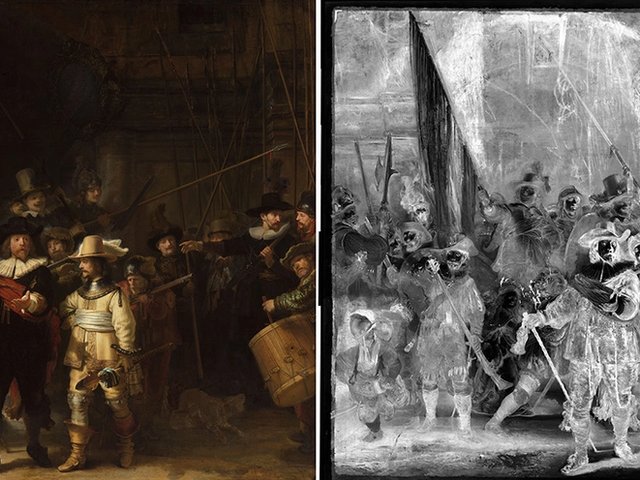
Rijksmuseum discovers 'the genesis' of Rembrandt’s Night Watch

Martin Bailey

Keune adds: “Ideally, you want to have the bacteria of Rembrandt: this is the Holy Grail. I think bacteria can survive for a very long time. A lot of research focuses on finding something like DNA or a fingerprint, because you get close to the artist.”

Recent research at the Rijksmuseum showed that, unlike his 17th-century contemporaries who prepared their canvases with a layer of glue, Rembrandt used an oil-lead mixture to stop his works going mouldy in Amsterdam’s damp buildings. This may have had a preventative effect on microbial growth. But in order to preserve such masterpieces, apart from gentle daily maintenance, they are only deep-cleaned around once every 50 years.

Eline van Bloois, a microbiologist at Artis-Micropia, hopes that the project will do wonders for the reputation of bacteria. “The comparison between a massive masterpiece and this invisible life is already amazing,” she says. “Often, they get a bit of a bad reputation, but microbes are not inherently good or bad.”

Van Bloois points out it is estimated that only a tiny fraction of microbes can cause illness in humans or animals. “We also know that, in some cases, it actually also helps train our immune system to be exposed to some of those microbes that may be able to cause usually minor disease,” she says. “It’s good to give microbes some love as well.”
Subscribe to our daily newsletter

MuseumsResearchThe Night WatchRembrandtScience and ArtRijksmuseumMuseums & Heritage
Share
Subscribe to The Art Newspaper’s digital newsletter for your daily digest of essential news, views and analysis from the international art world delivered directly to your inbox.
Newsletter subscribe
Information
About
Contact
Cookie policy
Data protection
Privacy policy
Frequently Asked Questions
Subscription T&Cs
Terms and conditions
Advertise
Sister Papers
Sponsorship policy
Follow us
Instagram
Bluesky
LinkedIn
Facebook
TikTok
YouTube
© The Art Newspaper

Related content

Discoveriesnews
2 March 2026

‘Lost’ painting reattributed to Rembrandt by Rijksmuseum’s researchers

The Dutch museum has undertaken a two-year study of the 17th-century work "Vision of Zacharias in the Temple"

Senay Boztas
Conservation news
23 September 2025

Dog in Rembrandt’s The Night Watch was copied from widely available book, suggests new research

The discovery comes as the masterpiece by the Dutch artist is undergoing a long-term public restoration at the Rijksmuseum in Amsterdam

Senay Boztas
Conservation news
21 December 2023

Revealed: the damp-proof lead layer protecting Rembrandt’s The Night Watch

Scientists discovered extra seam during Operation Night Watch conservation project at the Rijksmuseum

Senay Boztas
Museums & Heritagenews
11 March 2025

Rijksmuseum gives place of honour to newly acquired still life by Golden Age artist Maria van Oosterwijck

Painting by 17th-century Dutch painter has been researched and restored as part of the Women of the Rijksmuseum project supported by Chanel

Louis Jebb