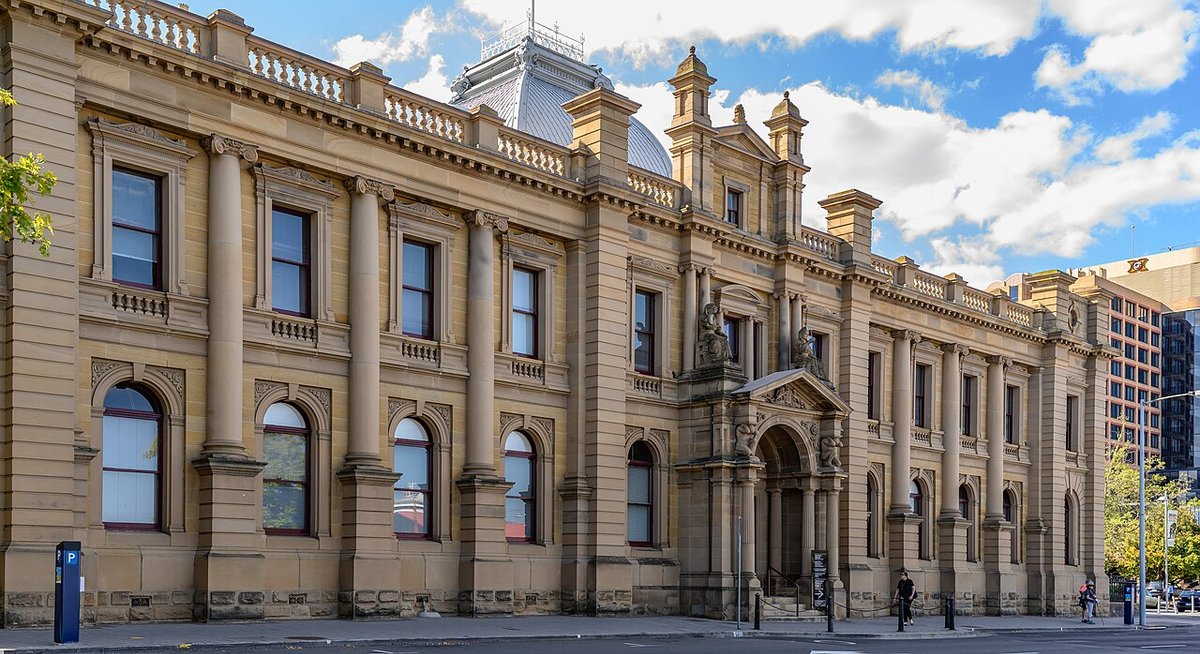
More than 100 prominent figures across arts, politics and the media have published a joint letter criticising proposed job cuts at the Tasmanian Museum and Art Gallery (TMAG), Australia’s second oldest institution. The signatories include the former Tasmanian premier Lara Giddings and the 2014 Man Booker Prize winner Richard Flanagan, along with 44 leading-scientists representing universities in the UK, Europe, Canada, USA, Russia and Australia.
TMAG, founded in 1848, is the only institution in Australia that encompasses an art gallery, museum and herbarium. Its “science collections are really critical on a global scale for research around climate change and species extinction,” explains Ian Terry, the chair of Friends of TMAG and the museum’s former senior curator of cultural heritage (2006-2017).
Highlights of the TMAG collection include a rare taxidermied Thylacine, colonial-era art, objects and more than 12,000 Tasmanian Aboriginal cultural artefacts.
Staff at the TMAG were briefed in August that up to 19.7 full time equivalent (FTE) jobs, or roughly 30% of its workforce would be axed to rein in government spending. The government has disputed the claim that the scale of the required cuts has been confirmed; a spokesperson is quoted in ABC News as saying “TMAG is not required to reduce its workforce by 30%”.
However, since news of cuts were made public Tasmanian MPs, TMAG’s executive and its board have received more than 25 letters from prominent European scientists that have decried the government’s planned cuts, and warned its decision to axe the head of the Tasmanian Herbarium, Gintaras Kantvilas, an internationally renowned biologist, would have “consequences far beyond Tasmania”.
This week’s letter called for the Tasmanian government to recognise its “statutory obligation to care for approximately one million objects of inestimable value” and “reconsider the proposed job cuts with their unintended deleterious consequences on the Tasmanian economy.”
“I want TMAG properly funded. I want the life-changing childhood experiences I had at TMAG to be available to all Tasmanians forever,” David Walsh, the founder of Hobart’s Museum of Old and New Art (MONA), and one of the letter’s signatories, wrote in a separate letter that was published in Hobart’s Mercury newspaper this week. “I put stuff on Mona’s wall because TMAG put stuff in my heart,” he added.
The proposed job losses are part of wide-ranging cost cutting initiatives being rolled out by the state Liberal government, as part of an attempt to rein in the state’s ballooning debt, which is projected to reach A$9.9bn (£5bn) by 2027-28. These initiatives include a plan to slash up 1700 public sector jobs by 2032.
Although the government disputes the scale of the proposed staff reductions, when a new organisational chart was shown to staff in late September it identified “seven positions that were definitely to be cut,” Terry says. Those positions included two positions at the herbarium, a biologist, a graphic designer, a photographer, the museum’s only exhibitions officer, as well as the amalgamation of the vertebrate and invertebrate zoologist into a single role.
Asked about the government’s dismissal of the claims about a higher number of staff losing their jobs, Terry explains that over the last 12 months the museum has already lost “quite a lot of staff” through natural attrition and redundancies. “I suspect some of those positions were included in the 19.7 figure,” he says.
TMAG and the Tasmania state premier’s department has been approached for comment by The Art Newspaper.
Funding cuts
According to independent budget analysis provided by the Friends of TMAG, the proposed changes under the broader cost-cutting initiative would also see TMAG move under the control of a new government agency called Building Tasmania and lose up to 27% of its funding for 2027-28 while its targets for physical visitation increase by 6.4%. TMAG is already “seriously underfunded”, says Terry. Its current exhibition Becoming Modern: Mid-century Australian Art has a 16-month run. “That's unheard of,” Terry continues, adding he thinks that “locals will be going less often because you're not going to go back many times to look at the same exhibition”.
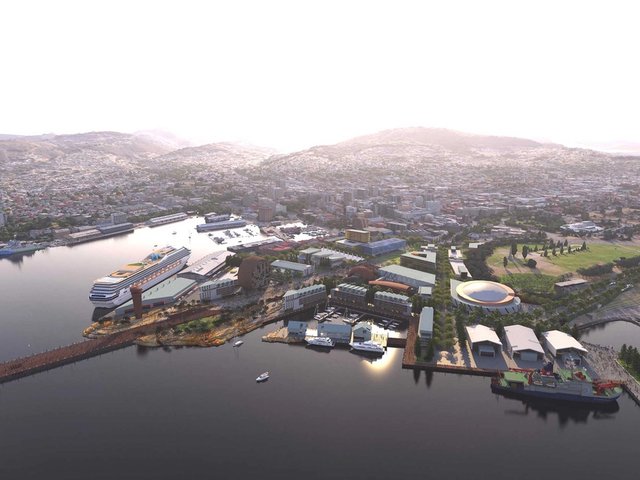
A state government spokesperson says there is no correlation between the cost cutting measures and a new A$1.13bn (£573m) football stadium planned for Macquarie Point, a location that was once earmarked for a truth-and-reconciliation art park proposed by Dark Lab (a subsidiary of MONA). However, the independent MP Peter George asked in a statement issued on 25 September: “where’s the money [for that stadium] coming from?”
The proposed cuts to staff numbers are currently under review by the Tasmanian Industrial Commission and Tasmania’s Upper House is voting on calls to reverse cuts to TMAG’s budget. Decisions on both issues are expected on Tuesday 24 November.
At the time of writing both Gintaras Kantvilas, the head of the Tasmanian Herbarium and Simon Grove, a zoologist and curator of invertebrates, have said they have had their positions reinstated after they had been under threat due to the proposed cuts.