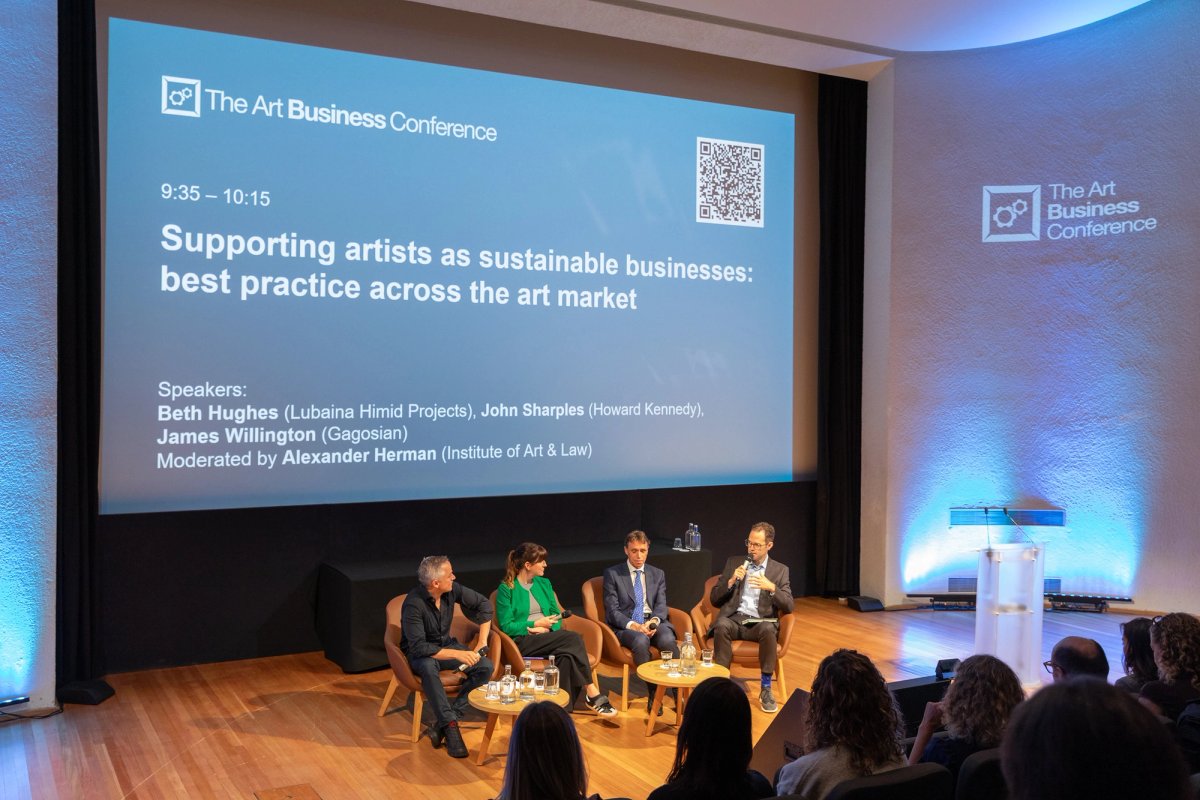

At the Art Business Conference in London in September, I was fortunate enough to moderate a panel discussion about artists as sustainable businesses. How are artists best supported in the current art market ecosystem, and what specific roles do galleries and studios play? It was not long before one panellist made a bold suggestion for legislative change in the UK to protect artists consigning works to galleries.
We have witnessed several gallery insolvencies of late. What then happens to an artist’s consigned stock when a gallery goes bust and the liquidators move in? The situation can be especially perilous for the artist if the gallery has been keeping their work with an unpaid third-party storage company. There is a fear that the artist may never see the art again, since recovery is usually premised on paying unpaid storage costs. It may sound like the art is being held hostage, although I am told that reasonable deals can sometimes be worked out.
In the US, unlike the UK, many states have statutes that seek to protect artists from unscrupulous financial machinations by dealers. In 2012, New York went one step further by forcefully requiring dealers to hold works on trust for artists and to keep money accrued on artists’ behalf in trust accounts rather than mixing it with general operating funds. That way, in theory, artists can be more predictably paid after each sale and, in catastrophic times, rescue their funds once the ship goes down.
A safety net for artists
The panellist was the art lawyer Jon Sharples, who repeated his call for the UK to pass similarly protective legislation in an article for The Art Newspaper in 2023. There are compelling reasons for doing so: it offers a safety net to artists and it would not harm the London market vis-à-vis New York, since galleries in the latter would already comply. In fact, it is possible that major galleries with footholds in both jurisdictions already comply with the more stringent requirements across all their operations (though it is hard to know this for sure).
Contemporary art galleries are unlikely to applaud the possible imposition of new legal obligations. Galleries already take significant financial risk, investing in artists to support the development of their careers. Onerous regulatory demands already exist in the UK: anti-money-laundering rules, data protection and artist resale royalties, none of which are shared by New York galleries. For small galleries living hand to mouth, could this be the straw that breaks the camel’s back?

Sharples nimbly suggested another, separate layer of protection for artists, one already present in the law that is not well known—and one that does not require new legislation: the law of agency. At common law, agents act as fiduciaries on behalf of their principals. Mapped onto the art world, galleries are fiduciaries for their artists and so owe them fiduciary obligations. This would include duties to account, a prohibition on secret profits and a general requirement to treat the artist’s interest as they would their own—the Golden Rule, as adapted to the art market.
So, is new legislation required for commercial galleries in the UK, or is it simply that galleries need to better understand the duties they already owe their artists? Sharples, I suspect, would like to see both, especially since only legislative change would help in cases of insolvency. Short of that, perhaps the answer is also more education.
Should the legislative route be contemplated in the UK, the art sector would need to be united in its advocacy. At present, there are different sector bodies, but no umbrella organisation to represent them all. There are calls, however, for a UK visual arts trade body, much as there is for music. As it happens, that was the topic of the next panel at the conference, but I’ve run out of room!