Back in 2000 I identified Mark Wallinger as “one of Britain’s most inventive and conceptually nimble artists … not one to blanch at big subjects”. This remains the case, except that now I’d say Wallinger’s consistent ability to give powerful visual expression to complex and politically trenchant ideas around art, identity, the nature of human perception and sometimes even of our very existence is pretty much unsurpassed not just in the UK, but anywhere. His latest work, currently in two shows in Northampton and London, confirms he has lost none of this ability to fuse the deeply intellectual with the immediately accessible in unforgettable ways.
Over the years, Wallinger’s art has ranged from meticulous paintings of racehorses—one is provocatively titled Race, Class, Sex (1992)—to Ecce Homo (1999), said to be the first prominent statue of Jesus Christ in a public secular civic space in England since the Reformation, which premiered on the fourth plinth in Trafalgar Square in the run-in to the millennium. Not many artists attempt to address the meaning and purpose of religion in today’s society, but Wallinger’s Christ figure managed to find almost universal favour among both the devout and unbelieving as well as traditionalists and champions of radical art. Besides having a spell on the steps of St Paul’s Cathedral, Ecce Homo was part of Wallinger’s exhibition when he was Britain’s representative at the 2001 Venice Biennale.
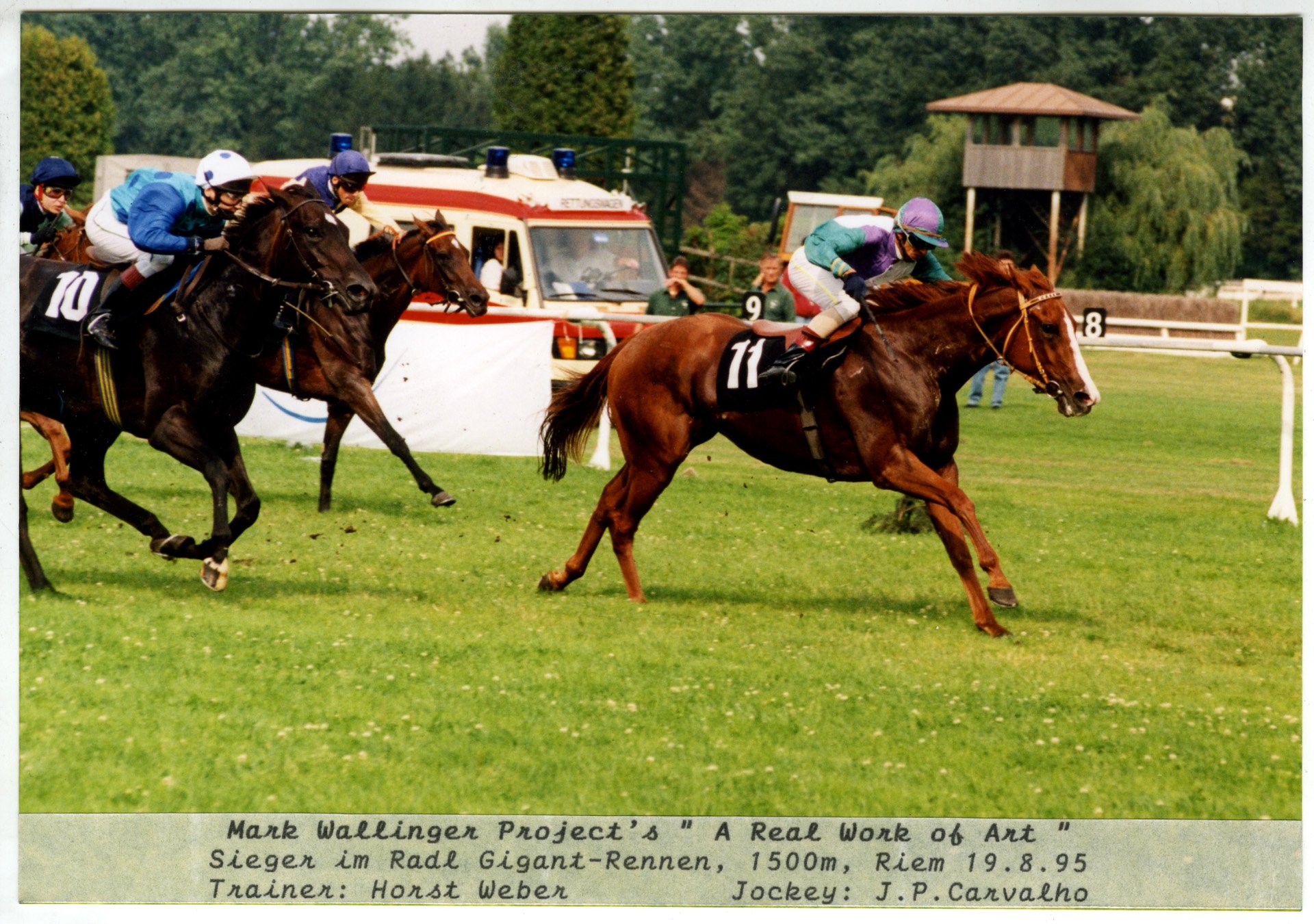
Mark Wallinger, A Real Work Of Art, The race in Riem, that she won is 19 / 8 / 1995
© Mark Wallinger
Art on the hoof
One of my most memorable journalistic assignments was a recording for BBC Radio made in the Newmarket stable of a thoroughbred racehorse which Wallinger ran in the 1994 flat season under the name A Real Work of Art. Wallinger pointed out that no species in the world was more closely documented, artificially bred or subject to cold financial considerations than the racing thoroughbred. He also subverted the traditionally male bastion of the Jockey Club by registering his equine artwork in the green, violet and white of the Suffragette movement.
These days, Wallinger continues to use a wide variety of means to explore the fundamental forces, whether physical, political or existential, that structure and shape our world. But now he employs less elaborate methods and media to probe our surroundings, belief systems and ways of seeing.
The new series of Field Paintings currently on show in London and Northampton are the latest in his ongoing grappling with notions of the infinite and the sublime. But while their conceptual origins lie in the graph system of René Descartes, which plots co-ordinates in two and three dimensions, the arresting moiré effect of their shimmering, constantly changing surfaces was achieved by the simple device of superimposing layers of everyday polyester mesh used for the cheapest of net curtains. “It’s the magic of polyester and manufacturing,” Wallinger declares. “They’re all perfect tiny grids, but once they fall out of conformity with the layer below, then these organic shapes start appearing and they create a space that is very hard to actually imagine—are they acting like particles or waves? It does boggle the mind a bit.”
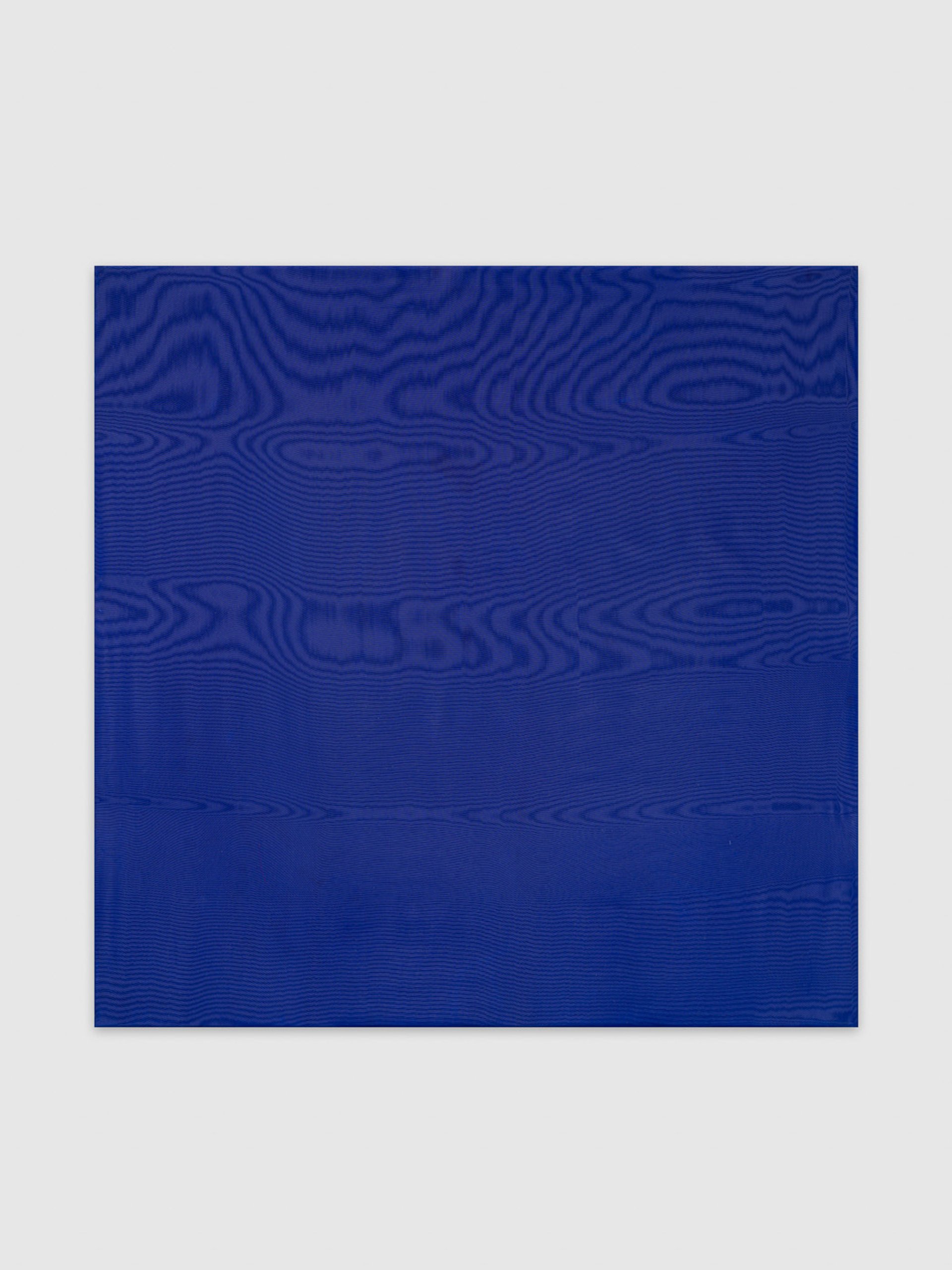
Field Painting 8’ 2026. Voile on stretcher. 90.5 x 90.5 cm © Mark Wallinger Photo: Damian Griffiths
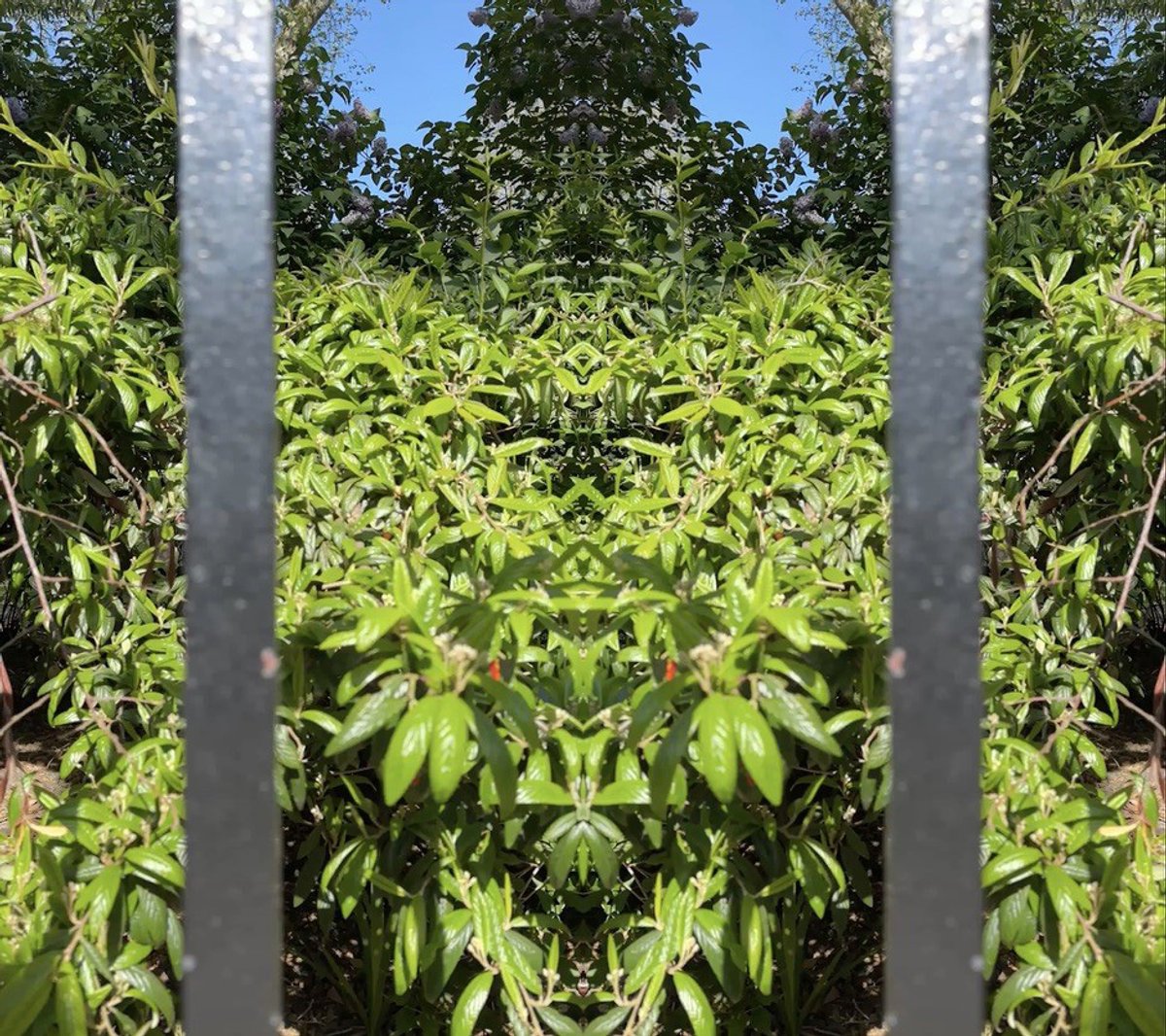
Also boggling the mind while simultaneously pleasing the eye in both shows is a startling new film, The force that through the green fuse drives the flower, named after the Dylan Thomas poem. The film involves Wallinger circumnavigating London’s Bedford Square armed with nothing more than an iPhone, a steady hand and a formidable armoury of erudite references, to further investigate the phenomena of nature and art’s effect on human perception. He admitted to me that he has “a bit of fascination” with this Georgian garden square which since the 18th century has been a hub for radical enquiry. He is particularly excited by the serendipitous chiming of the square’s distinctively oval garden with a comment by the philosopher Bertrand Russell (grandson of the Duke of Bedford, who owned the square) about how the planets move in ellipses rather than neat circles—proof, he says, of Russell’s observation that “nature does what it does, not what we should wish”.
In The force that through the green fuse drives the flower, two identical versions of his filmed springtime perambulation around Bedford Square are spliced together, resulting in explosively trippy and Rorschach-like looped footage that seems to erupt out of the centre. In this latest attempt to express the inexplicable, Wallinger rises above and beyond his cerebral sources to act immediately on the senses before the intellect kicks in, and, as he puts it, “to make art work”.
• Mark Wallinger: Circling the Square is at Paul Stolper Gallery until 24 October; Mark Wallinger: Field is at Arts Collective Northampton until 22 January 2027