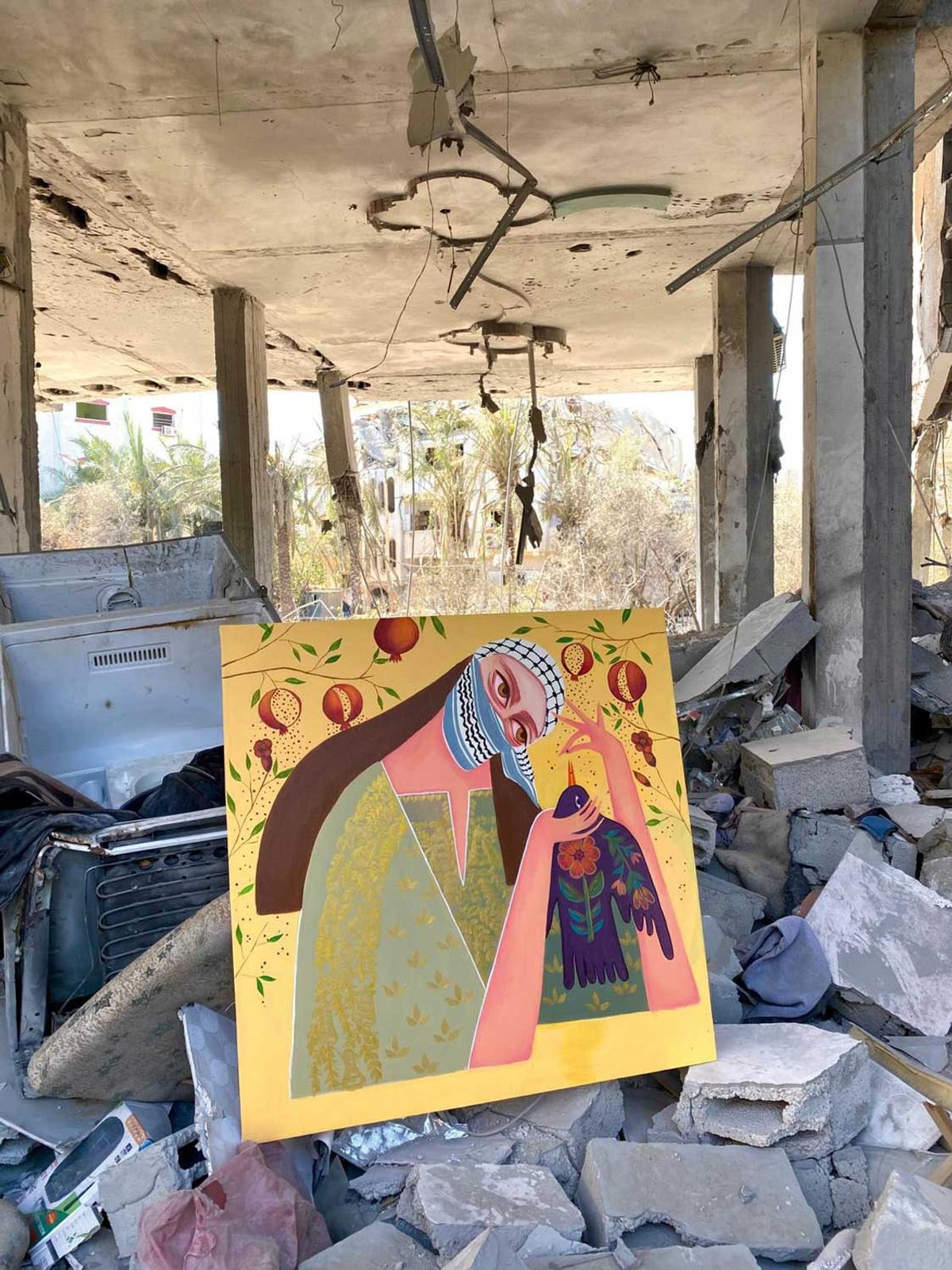
The colour that the Palestinian artist Asma’a Jeathni understands best now is red. Ever since she witnessed the severed head of her childhood friend hanging from an olive tree outside her house, a piece of bread still in her mouth, after an Israeli missile struck the house in December 2023, red has never been the same for her.
“That was the first time I understood the power of the colour—the colour of tragedy,” she tells The Art Newspaper. “We survived the bombing. But I did not survive that scene. It has stayed with me.”
A year after a ceasefire came into effect in Gaza on 10 October 2025, Jeathni, like many others, is still grappling with what she experienced during the preceding two years of war, while living in dire conditions amid continued Israeli attacks. According to figures released in August by the United Nations Human Rights Office, more than 1,200 Palestinians have been killed since last October.
Yet art has offered the 30-year-old Jeathni and others an escape throughout the ordeal—a way to find peace, document life and keep busy despite the challenges. These are the stories of four Palestinian artists, inside and outside Gaza, who despite devastating loss remain dedicated to their practices.
Asma’a Jeathni
The attack destroyed her neighbour’s house in Gaza’s Al-Zahra neighbourhood and damaged Jeathni’s home, which was filled with displaced relatives. She and her family fled with only what she could fit into a single bag. Her father had been undergoing kidney dialysis before the war; medication and food were scarce, and his body finally gave up in June 2024, while he still believed he would return home.
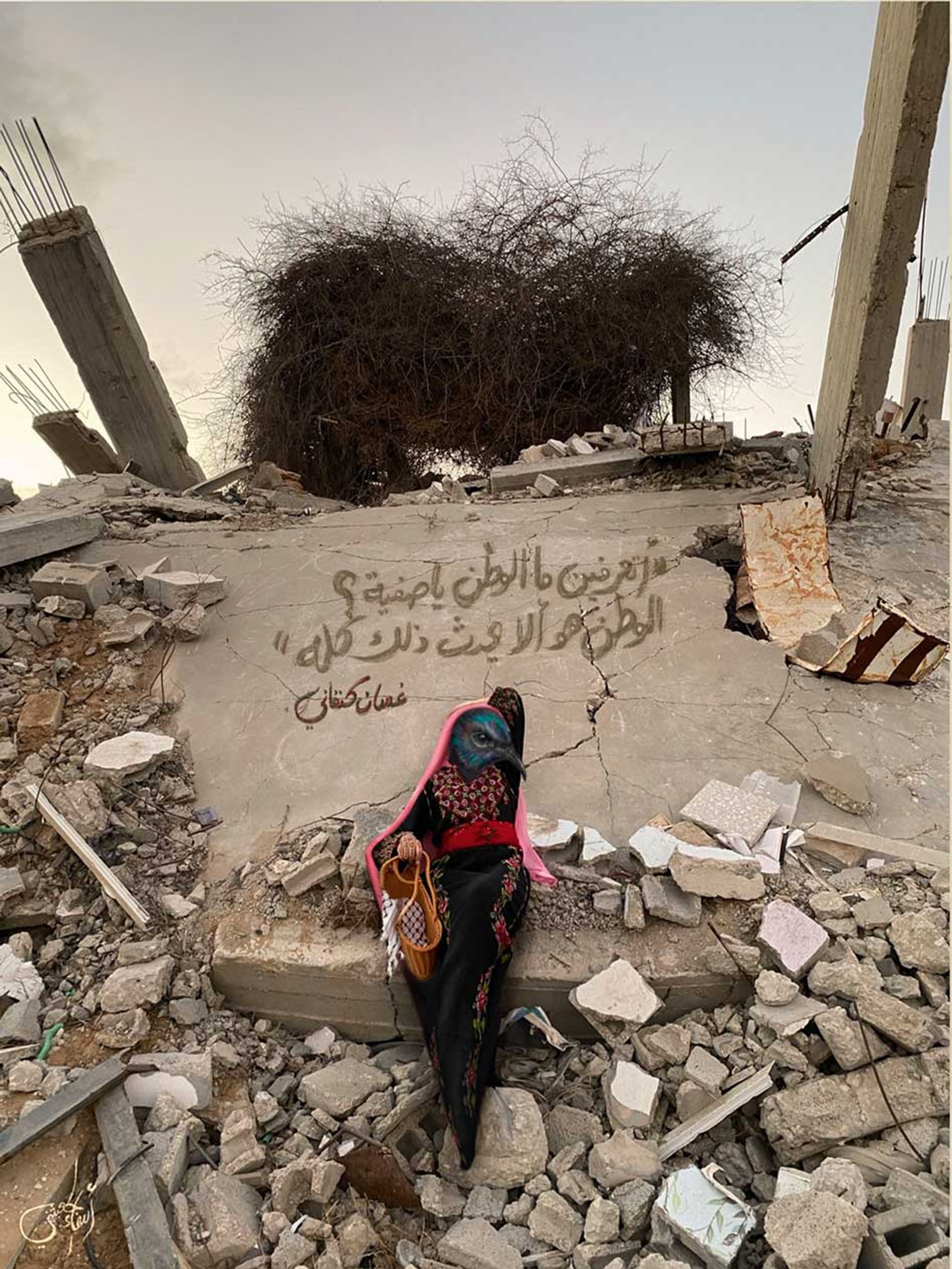
Asma’a Jeathni's work is in Shababeek’s online show Courtesy Shababeek
“Losing him was one of the most painful experiences of my life. It still affects me and how I see life and art,” Jeathni says.
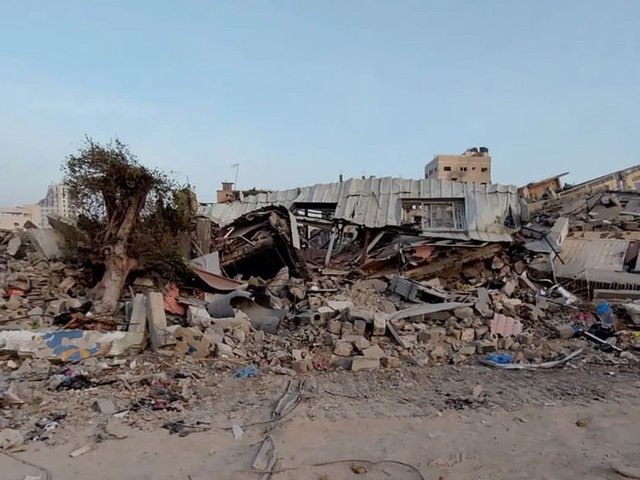
Two months later, the family home was destroyed in an overnight Israeli attack, shattering her hopes of returning to her studio. “That’s when I felt that displacement was no longer temporary,” she says. “It had become real homelessness.”
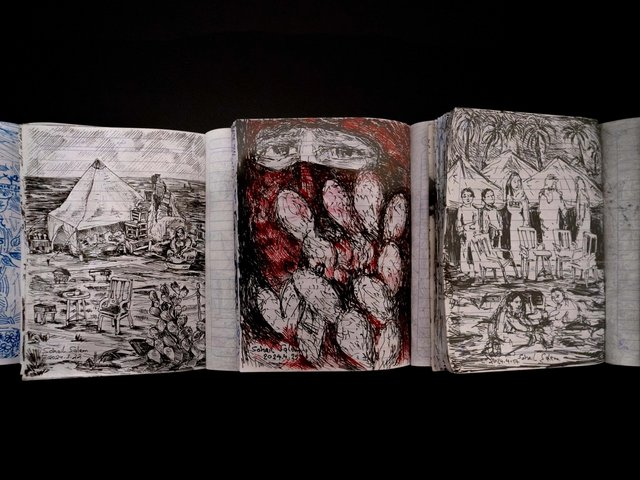
As the Israeli blockade deepened the famine, Jeathni learned which cactus could be eaten and even drank water infested with insects rather than going thirsty. With her canvas and paints lost, she turned to digital art and drew her experiences. “I tried to render these things beautifully—not because reality was beautiful, but because I needed a small space in which I could breathe,” she says.
When the ceasefire came, the family had no home to return to. Jeathni’s family of seven now lives in a single room in her uncle’s home in Nuseirat. Despite the ceasefire, she says she is “very afraid to leave the house”, not for fear of dying but of “losing a limb or being injured in a life-changing way” in ongoing Israeli attacks.
She works as an arts facilitator, running activities and psychosocial support sessions for women and children in displacement camps, teaching them to recycle scraps and turn their “temporary surroundings into a space for expression and emotional release—even into things that add a bit of beauty to our surroundings”.
Her displacement led to the series Struggle of the Sparrows—A Visual Exile. At its centre is the Palestinian sunbird, associated with local trees, flowers and nectar. Jeathni superimposes it on a woman, as it builds its nest from whatever it can find. It is an image, she says, of “a person who has the capacity to dream and to move, yet finds themselves confined within borders and conditions imposed on them”.
She created the series for Wasla (Arabic for “connection”), an online exhibition organised by Shababeek for Contemporary Art, one of Gaza’s oldest contemporary art spaces, which was destroyed in the first year of the war.
Jeathni says art has become a form of resistance. “I am trying to survive through my art and to say, through it: ‘I am here, this is my story and this is a life that has value.’”
Jehad Jarbou
Another artist selected for Wasla is 27-year-old Jehad Jarbou from northern Gaza’s Al-Saftawi area. On 9 November 2023, an Israeli strike collapsed her home while her family was inside preparing breakfast. “We felt nothing except the sound of the house collapsing on top of us,” she says.
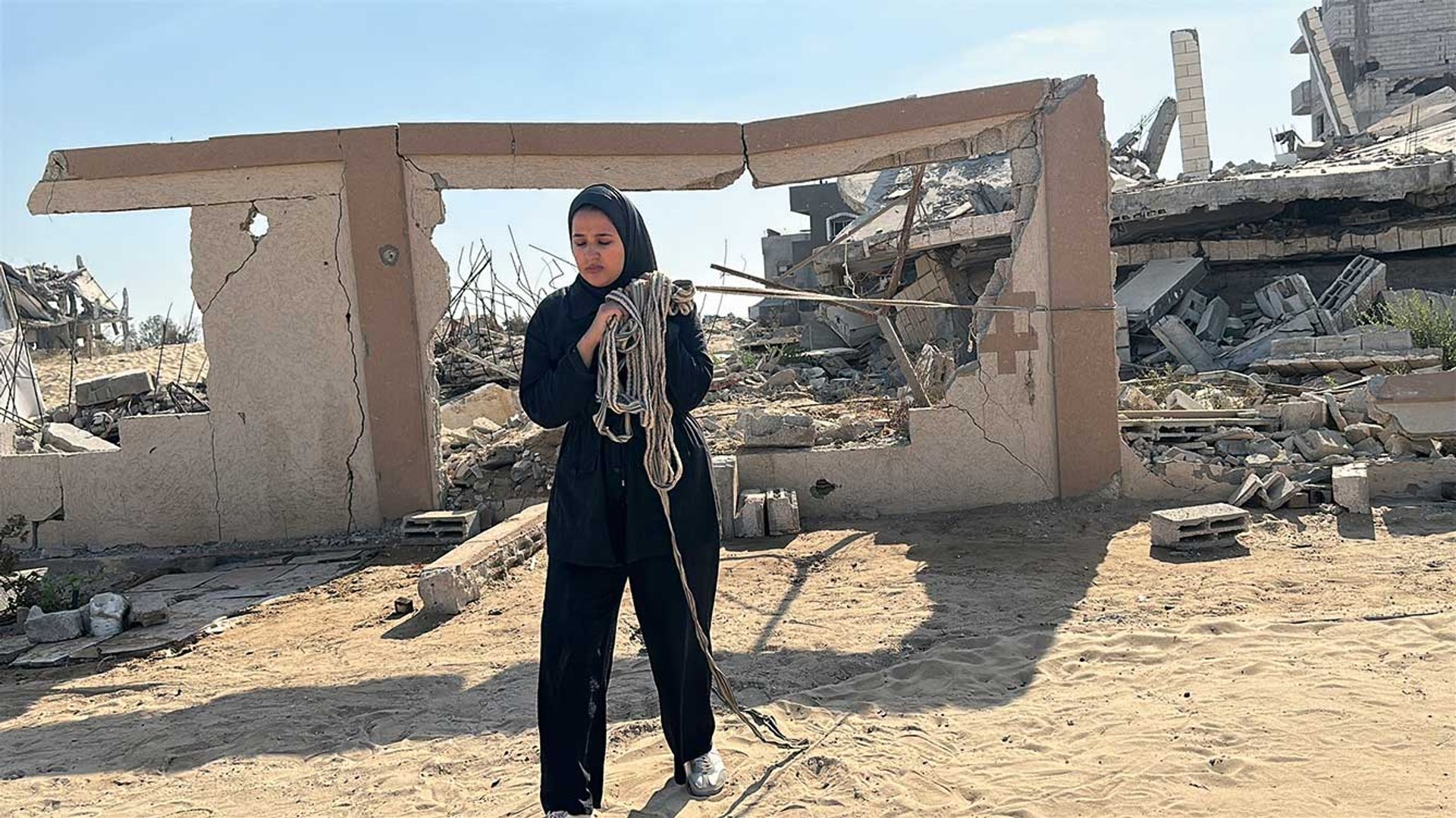
Shababeek’s online show includes works by Jehad Jarbou Courtesy Shababeek
Her father died on impact and her 18-year-old brother Hassan died in her arms from his injuries. With Israeli tanks nearby, no ambulance could reach them, she says. Jarbou, her mother and her youngest brother, who had “miraculously survived”, carried the bodies to the nearest medical point and then to the cemetery before fleeing south.
“There was no time for grief or farewell. We had to leave,” she says. “I didn’t only lose family members; I lost my home, my memory and my artistic archive. All my works and art tools were destroyed.” She was displaced repeatedly, at one point living in a small tent in the street “alongside insects and rats”, with little water, privacy or food.
Amid it all, Jarbou married in 2024—she calls herself a “war bride”—and became pregnant. While in labour, she was forced to leave the European Hospital in Khan Younis after the area came under Israeli attack and moved to a field hospital, where she gave birth by caesarean section in a tent. “I saw death in front of me, people bleeding, and at the same time I was trying to bring new life into the world,” she says.
She now shares a tent with her husband, one-year-old son, mother and brother. “Sometimes I wish there were a magic door through which I could move my family from death to life, and from fear to safety,” she says. “And yet, I still hold on to art.”
A fine arts graduate, Jarbou has practised for eight years. Photography is her preferred medium and her own body is “a tool, a witness and a memory” to explore “women’s freedom, fear, pain and survival”. One of her works in Wasla shows her pulling a rope tied to the ruins of a destroyed home.
A tireless author, she is now more focused on writing, leading to several book collaborations, which are available to buy in Europe and explore memory, life and the Palestinian experience. With Gaza’s universities largely destroyed, she says her dreams of studying photography and film-making remain “a postponed dream—but not a dead one”.
Ahmed Muhanna
While online exhibitions and social media have been the most common ways for Gaza artists to reach international audiences, a handful have succeeded in getting their work exhibited beyond its borders. Among them is Ahmed Muhanna, a father of three who specialises in child therapy.
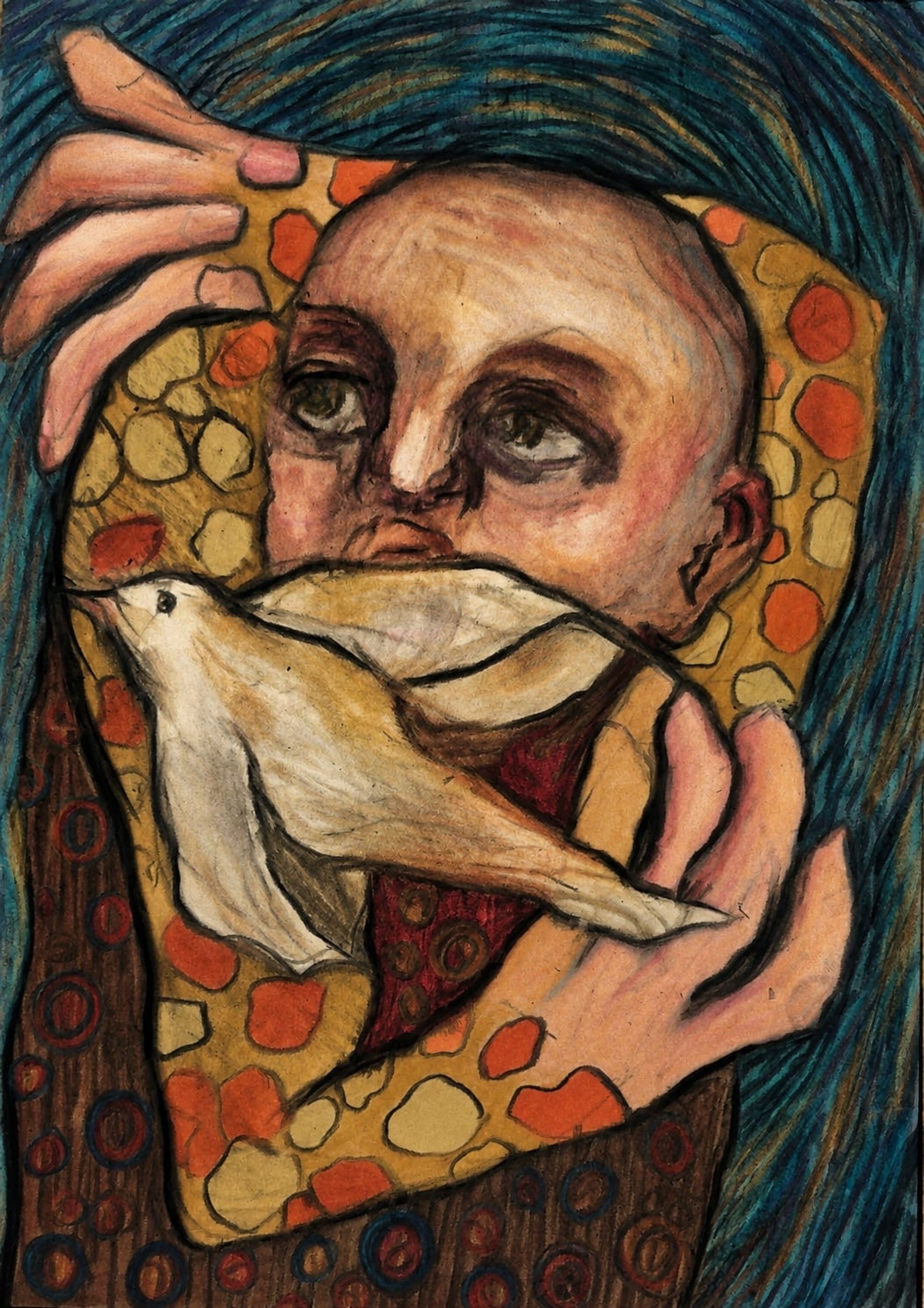
Ahmed Muhanna’s works on paper document daily life in Gaza Courtesy the artist
During the war, Muhanna began painting his surroundings and people’s daily struggles on scrap aid cardboard boxes and sharing the works on social media. His work caught the attention of the UN’s World Food Programme (WFP), whose boxes he used. The organisation helped take more than 40 works out of the enclave for Gaza: Stories of Hope and Resilience, a travelling exhibition that visited nine European cities last year. Its success led to a follow-up WFP exhibition, which travelled to seven European cities between May and June of this year.
“The project ended, but the reality I was depicting has not,” he says. He is pleased that his work reached “distant places” and carried Gaza’s voices to audiences, but he sees a painful contradiction in the fact that his art can travel freely while he remains “trapped in a large prison called Gaza”.
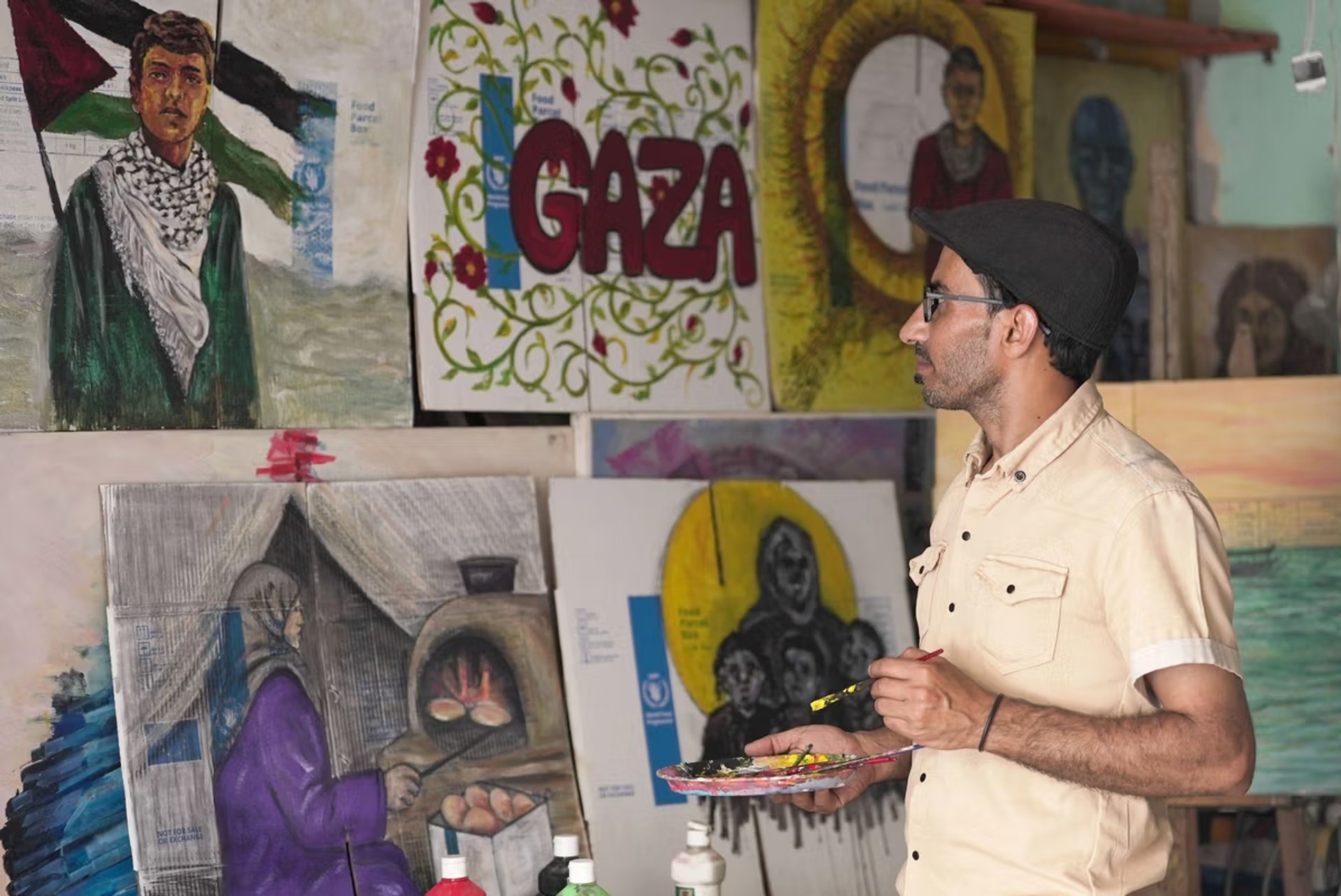
Ahmed Muhanna has explained that that he began painting on aid boxes due to a lack of art material
Photo: The United Nations World Food Programme (WFP)
His greatest concern is for his children’s future. With Gaza’s education system destroyed, his children, aged 12, ten and eight, have been deprived of schooling. “Education has become something postponed for them, even though their childhood cannot wait,” he says. “I hope that my children will grow up knowing that life can be more than just survival.”
Muhanna says conditions have become harder as Gaza and its people have fallen out of the news cycle. “The world has moved on to other news, while we are still living inside the same story,” he says. He tries to continue his art sessions for children, paying for supplies through a donation page. But donations have declined, which he believes is partly a result of the world becoming accustomed to images of Gaza’s suffering. “I am not asking the world to remember Gaza forever, but I hope it does not forget it so quickly,” he says. “I do not paint simply to remain an artist. I paint to say that we are still here.”
Raed Issa
For those able to leave, safety has not necessarily brought peace. “I survived the war, but surviving did not mean that the war ended for me,” says Raed Issa, a co-founder of Gaza’s Eltiqa Group for Contemporary Art, who now lives in Marseille.
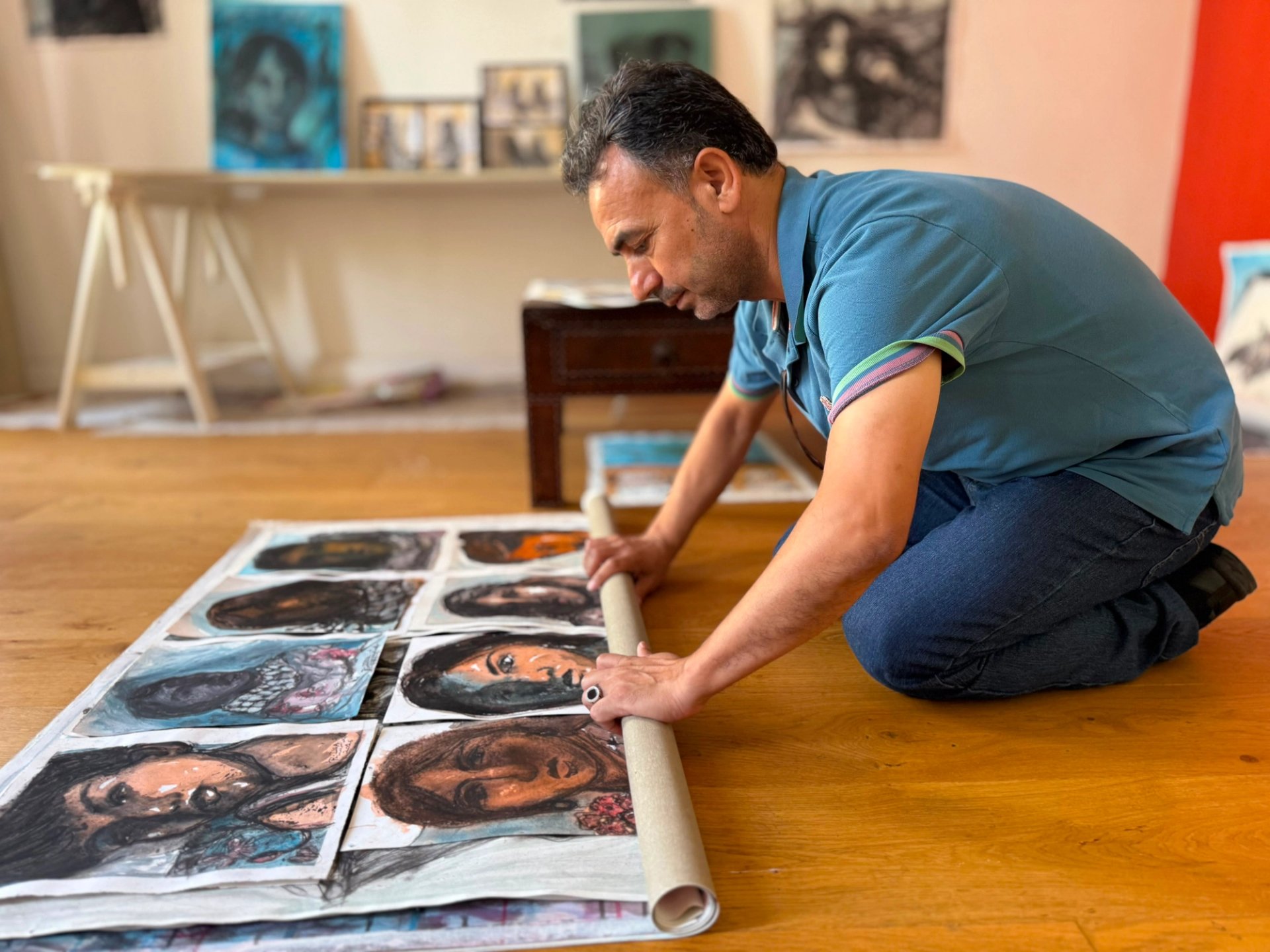
Raed Issa in his studio in Marseille The Art Newspaper
The father of four left Gaza for France in April 2025. His wife and children joined him several months later from Egypt, where they had fled in 2024. Issa had been denied entry to Egypt and spent a year separated from his family, repeatedly displaced and living in a tent in Gaza. The evacuation was sudden and he was allowed to leave with only the clothes on his back. The transition to France left him feeling disconnected and uprooted. “The trauma was more than a geographical displacement,” he says. “I felt that my body was in one place while my mind and memory remained somewhere else.”
During the war, Issa created continuously with whatever materials he could find, including hibiscus and coffee. In France, he initially struggled to return to art, feeling his new work lacked the authenticity of his Gaza-rooted pieces. Gradually, he found his way back, transforming memory, trauma and loss into a visual language.
One of his new works was presented in the group exhibition Ses racines s’étendent jusqu’à 7000 km (roots stretching 7,000km) at La Compagnie in Marseille this spring and summer. Issa re-created, to scale, the tent he built during his displacement in Gaza, sealing its surface in beeswax. Inside, black drawings document different stages of displacement: fear, anticipation, exhaustion, overcrowding, patience and fragility. Raised from the ground, the tent’s suspension represents a state of instability.
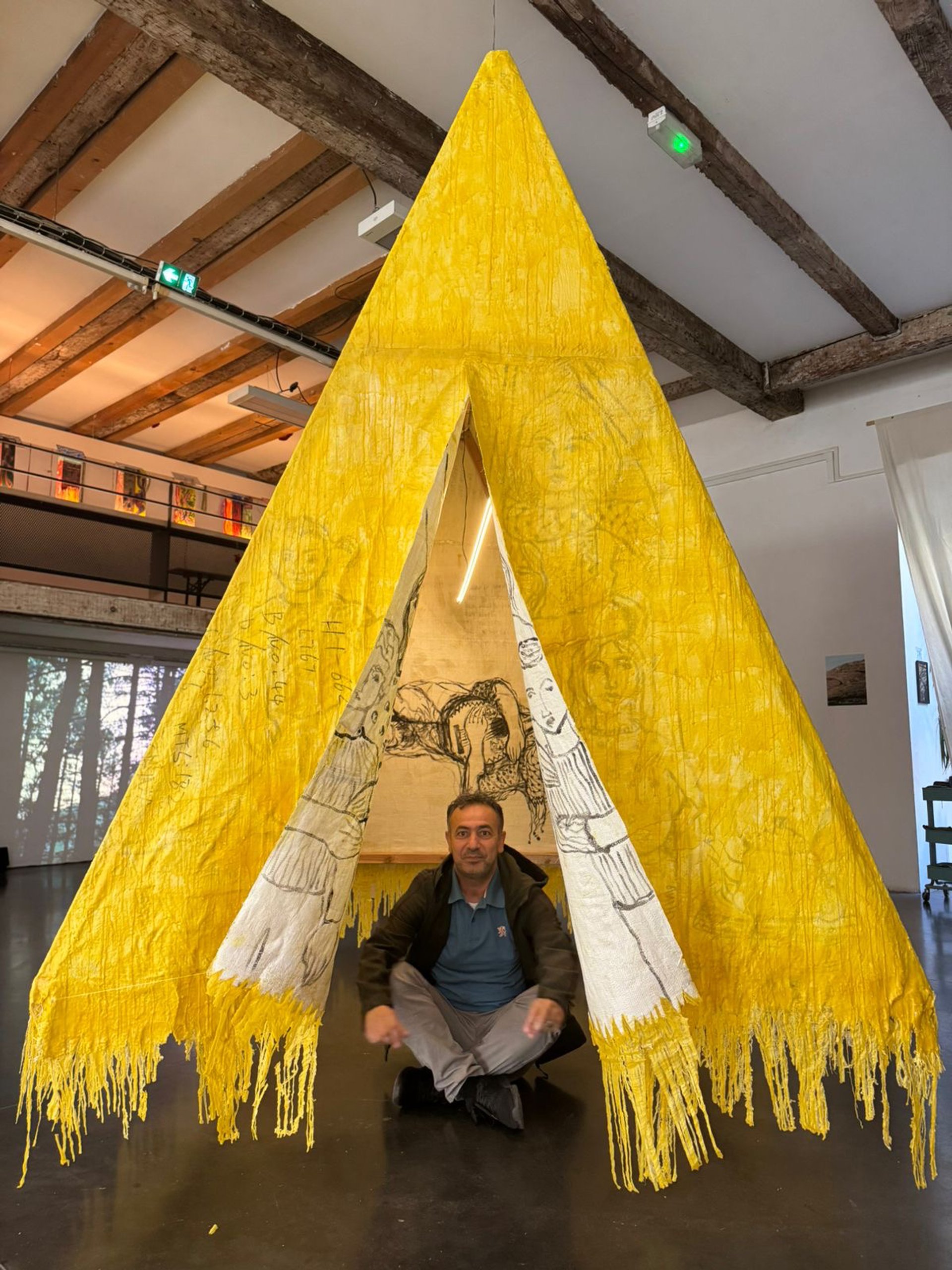
Raed Issa’s work is on view in Marseille
Courtesy of the artist
“When I enter the tent, I feel like I am back in Gaza,” says Issa. He continues to experience psychological distress, guilt and alienation. “It is difficult to feel that I am living a beautiful and safe life while the people I love are still living through war,” he says. “At times, I feel that I exist in two places at once: my body is here, but my memory, anxiety and heart remain there.”
Making art is a way to maintain his connection to the homeland he left behind, he says. “Art has become the space where I can hold this contradiction, trauma, loss and longing—and transform what I cannot express in words into image, material and memory.”