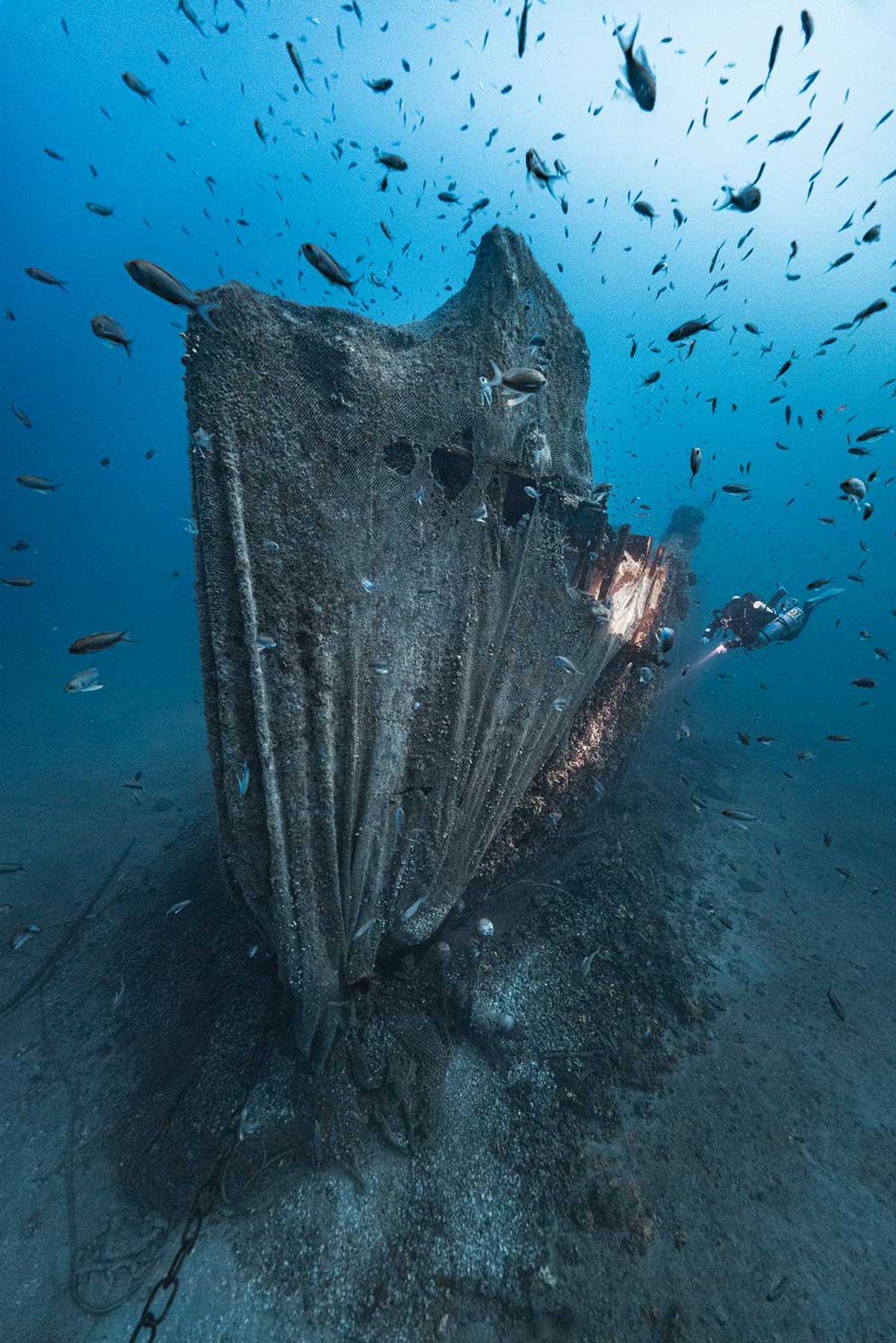
Shoals of fish weave through the twisted hulk of HMS Louis, which has rested beneath steel-blue waters off Turkey’s Gallipoli Peninsula for more than a century. A bright metallic frame is the only sign that a new battle is underway to fight corrosion and save one of the world’s greatest concentrations of First World War shipwrecks.
The device is part of a cathodic protection system the Turkish government is installing at the Gallipoli Underwater Historical Park, a large expanse of the north Aegean seabed that is on Unesco’s tentative list of World Heritage Sites. More than 100 Allied and Ottoman shipwrecks are evidence of one of the war’s bloodiest chapters, but time, salt water and rust have placed their long-term survival in doubt.
Cathodic protection supplies a weak electrical current to ensure that sacrificial anodes corrode instead of the ships, dramatically slowing deterioration. While the technology has shielded working ships since the 1800s and is widely used on offshore pipelines, this conservation project, called Deep Heritage, marks the first time the method has been deployed for shipwrecks on this scale, according to Yusuf Kartal, the head of planning and projects at the Gallipoli Historical Site directorate.
“Cathodic protection for wrecks is not widespread, because underwater cultural heritage [for this period] is still new… with the focus on older archaeological remains,” Kartal tells The Art Newspaper. “These ships contain the stories of soldiers who lost their lives here, [and] our primary objective is to leave this legacy to future generations.”
Without intervention, researchers estimate that the sea will claim armoured vessels over the next 50 to 75 years, while civilian ships will vanish sooner. Cathodic protection could theoretically preserve the sites for “hundreds of years”, Kartal says. “However, climate change is a major unknown. Rising water temperatures, lower oxygen levels, increased bacteria and pollution are issues we need to monitor.”
Over the next eight years, Deep Heritage aims to protect 17 sites, selected for their historical significance, accessibility and degree of corrosion, Kartal says. The project will also 3D-scan about 20 irreversibly damaged wrecks.
Legacy of a brutal nine-month campaign
Draped in algae and soft corals, the Louis lies about 13m below the surface at Suvla Bay, where it ran aground during the landing of Allied troops. Cylindrical boilers that powered steam turbines rise from the wreck in a wash of blue light.
Copper cables buried in the seabed connect the zinc anode to the Louis, the first wreck to receive cathodic protection last month. Kartal says the cost, about $1m, could rise four-fold for deeper and larger wrecks, such as SS Carthage, a transatlantic passenger ship requisitioned by the French navy for the campaign. Its six decks lie at a depth of 84m, and dive photographs show the gaping hole torn by a German torpedo and an intact superstructure, wooden planks and a curving staircase.
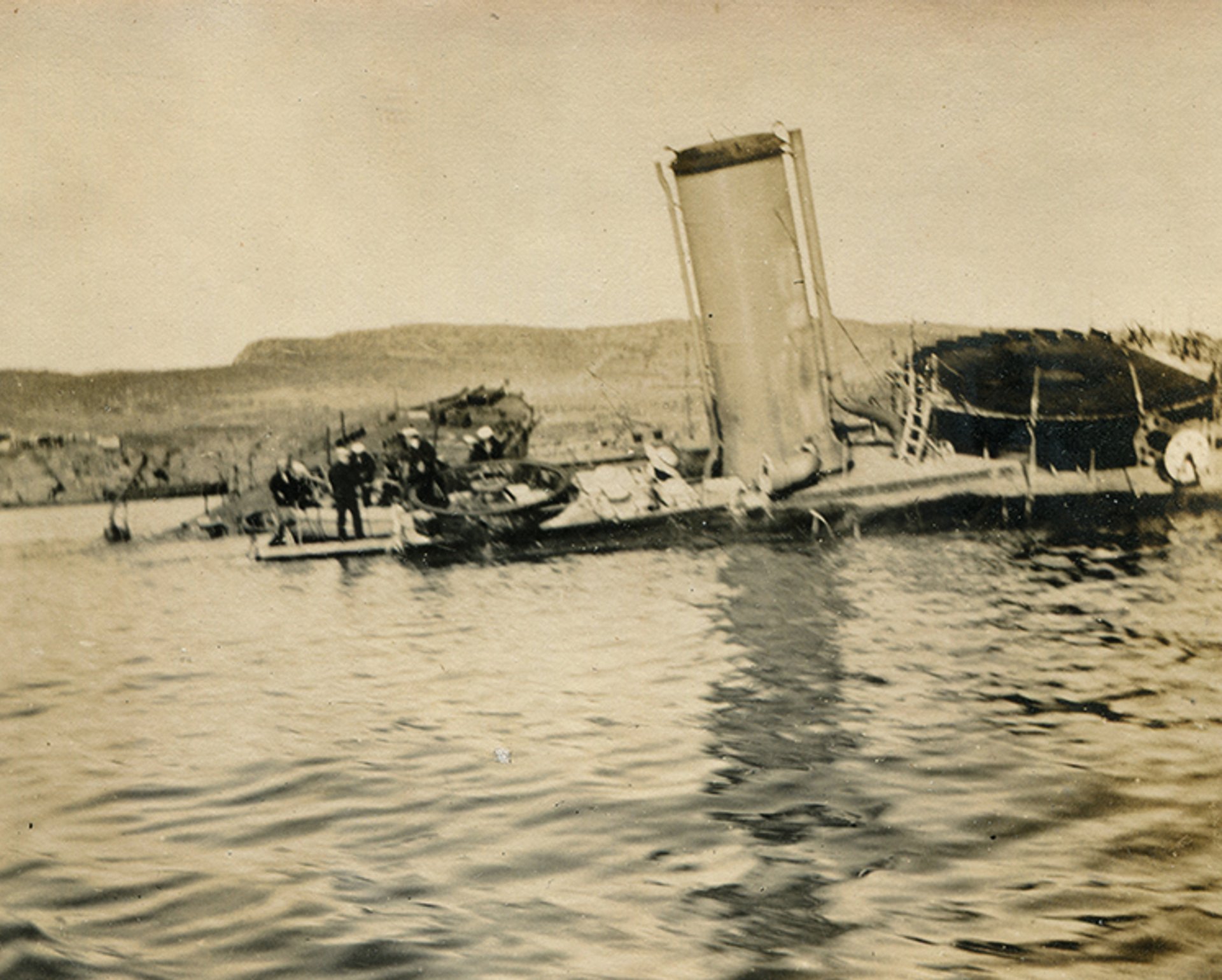
A historical image of British destroyer HMS Louis, the first Gallipoli wreck to receive cathodic protection Courtesy of Serpil and Bill Sellars
The Allies’ attempts to seize the Dardanelles Strait and knock the Ottomans out of the war in 1915 ended in defeat after nine months of brutal fighting on land and sea, scarring the peninsula with trenches and turning the sea into a graveyard of ships.
The most catastrophic naval loss was the French battleship Bouvet, which sank in under two minutes after striking an Ottoman mine, killing 639 men. It lies upside down at a depth of 68m, making it inaccessible for most divers. Resting on its side in 20m of water at Cape Helles is HMS Majestic, one of the oldest warships, and a popular dive spot.
“The quality of the wrecks is extremely good for the First World War, which makes them so special,” says Alex Dawson, an underwater photographer who has dived the area about 30 times in the last two and a half years. “Many are in very deep, dark, cold water that has preserved them well… There must have been little fishing in the area, because trawlers haven’t scraped them bare.”
This stretch of sea was largely off-limits as a military zone before it was opened for diving in 2022. It now hosts about 4,700 divers each year at 19 wreck sites, and the directorate expects the number of visitors to triple in the next ten years, which may increase risks to the wrecks.
“The ships around the peninsula represent the graves of thousands of men,” says Bill Sellars, an Australian writer and researcher who has lived on the Gallipoli peninsula for two decades. “It’s not desecration to visit the wrecks, as long as it’s a case of ‘look but don’t touch’. But any historical site can be subject to over-tourism. I have seen boats drop their anchors atop some of these wrecks.”
The worst damage occurred in the decades following the war, when scrap-metal scavengers, sometimes using dynamite, plundered wrecks in shallow waters. Kartal says that ship-breaking off the peninsula persisted until the 1970s.
At Anzac Cove, where the Australian and New Zealand Army Corps (Anzac) came ashore, thousands gather each 25 April for a dawn service to honour those who fought and died here. Just offshore in seven metres of water lies SS Milo, a passenger ship that supported the Anzac forces before being deliberately sunk to form a breakwater.
Today, the Milo is less a recognisable ship than a steel skeleton, largely erased by corrosion and salvaging. The vessel is too far gone for cathodic protection. Instead, it offers a warning of what is at stake for the other wrecks of Gallipoli.