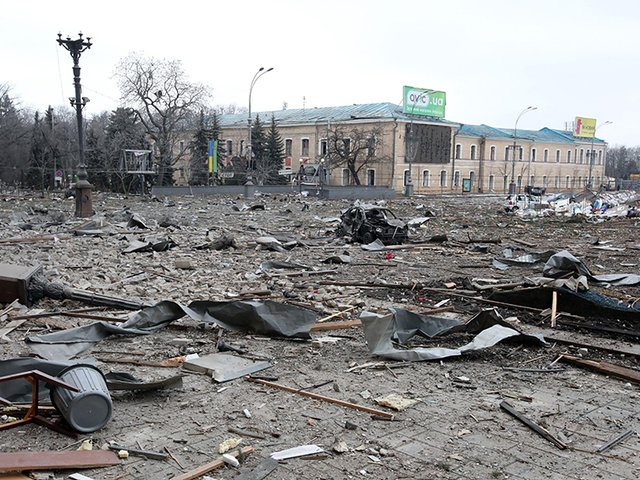
The headquarters of Ukraine’s Academy of Sciences, a landmark 19th-century building in central Kyiv, was struck by a Russian drone on Monday (28 September), killing two and forcing others to flee encroaching flames on ladders.
The Presidium of the National Academy of Sciences of Ukraine was founded by Volodymyr Vernadsky, a pioneering scientist, in 1918. It is housed in a building on Volodymyrska Street that was created in the classical style in the 1850s by the architect Oleksandr Beretti, who was also the co-designer of Saint Volodymyr’s Cathedral nearby. The academy oversees a network of scientific research institutions across Ukraine and advises the government.
Dramatic footage of the direct hit and extensive damage to the building has reinforced statistics indicating the targeting of Ukrainian cultural sites and symbols. As of 23 September, Unesco had confirmed damage, through multiple sources, to 560 cultural sites across Ukraine, comprising “164 religious sites, 283 buildings of historical and/or artistic interest, 43 museums, 33 monuments, 24 libraries, eight archaeological sites, five archives”.
In June a Russian attack damaged the Kyiv Pechersk Lavra, a Unesco World Heritage site regarded as a centre of Orthodox monasticism by both the Ukrainian and Russian churches, and the adjacent Mystetskyi Arsenal National Culture, Arts and Museum Complex. In August, a Russian drone destroyed an 18th-century wooden Cossack church in the Kherson region.
Last week, Tetyana Berezhna, Ukraine’s culture minister, said in a Facebook post that “as a result of Russian strikes on printing houses, publishing houses, and bookstores, more than 13 million new Ukrainian books were destroyed”. She added that “direct losses to the book industry already amount to at least 1.75 billion UAH”.
Ukraine’s foreign minister, Andrii Sybiha, in a post on X after the Academy of Sciences was hit, said Ukraine calls on Unesco “to strip the aggressor state of its voice, voting rights and its eligibility for election to any governing or working bodies.”
Meanwhile Vladyslav Havrylov, a Kyiv-based research consultant for the Leverhulme Centre for Research on Slavery in War, tells The Art Newspaper via WhatsApp that Monday’s strike is “not collateral damage” but a premeditated targeting of culture.
“It hits the institution that has safeguarded Ukraine's scholarly memory for more than a century,” he wrote.
Havrylov has been tracking reports of damage to Ukrainian cultural and religious for TOT Insights, the Leverhulme Centre’s research platform that maps out the impact of Russia’s illegal occupation of Ukrainian territory.
“It follows a clear pattern: in May, the National Art Museum, the Chornobyl Museum and the Philharmonic were struck in a single night; by spring, Ukraine's Ministry of Culture had recorded over 1,700 damaged heritage sites and more than 500 cultural facilities destroyed outright. Russia is targeting the places where Ukrainians produce knowledge about who they are. Each of these strikes must be documented as evidence of a crime, not only mourned as a loss. As a young scholar, I find it deeply painful to witness the destruction of Ukraine's scientific and cultural heritage.”