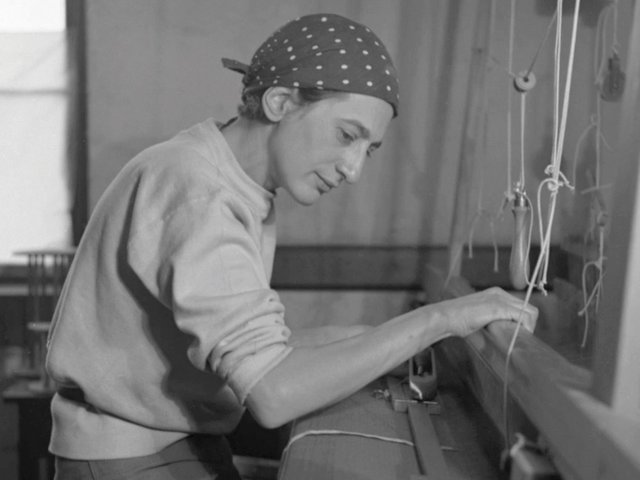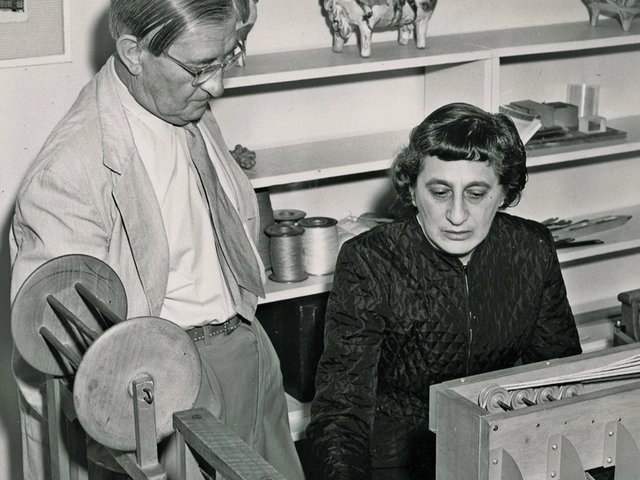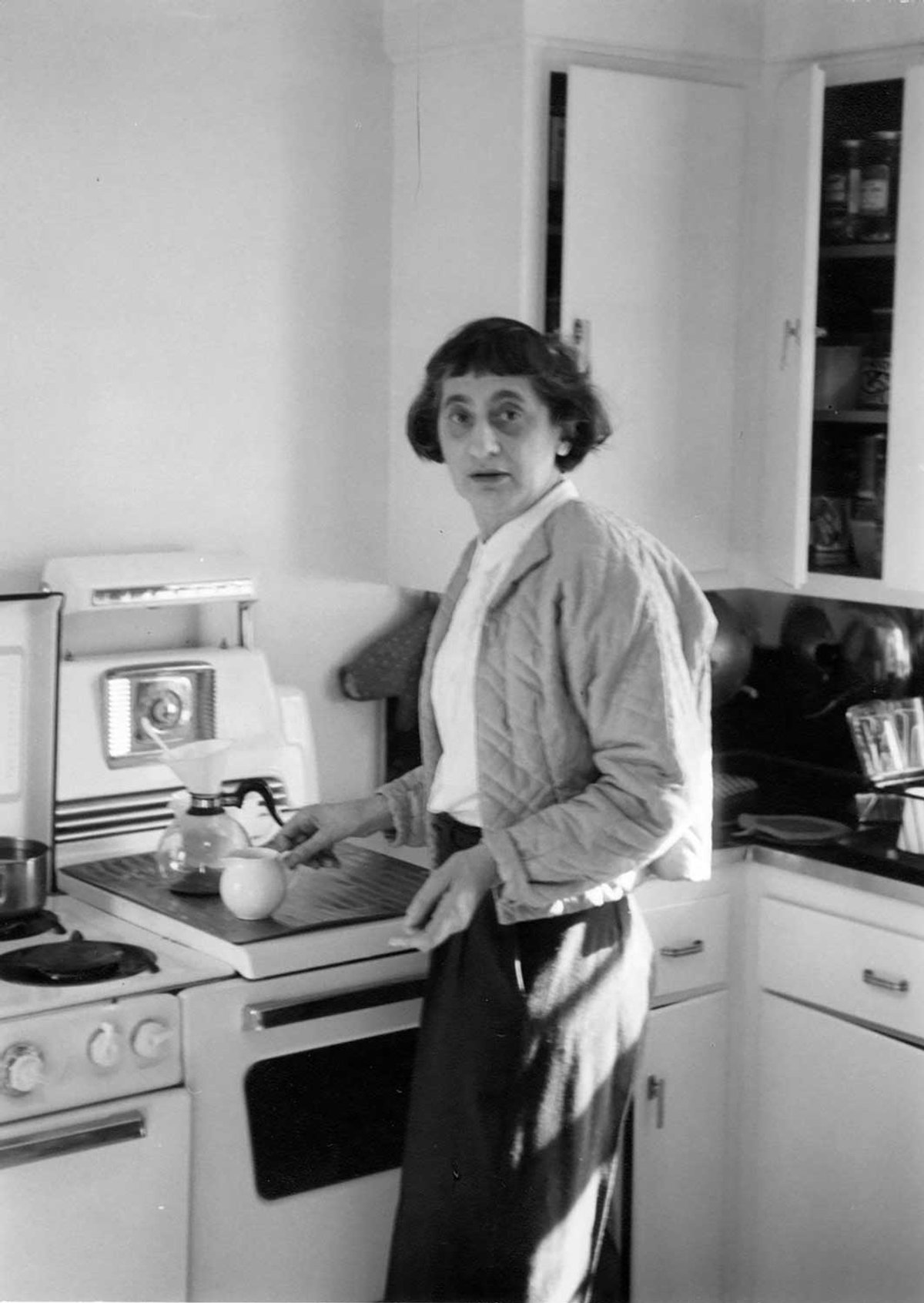
“Great art,” wrote Anni Albers (1899-1994), is “in essence, unaffected by subjectiveness.” Viewers encountering Albers’s spectacular wall hangings, intricate weavings showing gridded rectangles or lines of varying length, or both, might well believe that claim. Combining natural fibres with synthetic materials such as rayon, nylon and metal-coated threads, Albers’s textiles celebrate surfaces, not what is behind them. They tell us, it seems, little about their creator, nothing about her motivations or life experiences.
Imagine trying to write a biography of such a studiously self-effacing artist. Nicholas Fox Weber has done precisely that. His Anni Albers: A Life is the first comprehensive book devoted solely to the life of the often prickly German-born artist who revolutionised the history of 20th-century design, yet is still known mostly through her association with her husband, the abstract painter Josef Albers (1888-1976). Weber, the longtime director of the Josef and Anni Albers Foundation, has made it his life’s mission to pull Anni (as he invariably calls her) out of the shadows. Benefiting from decades of daily contact with the artist, his book retains the raw immediacy of personal exposure.
Anni found, Weber says, tranquillity in her weaving. She sorely needed it. Born Annelise Elsa Frieda Fleischmann in Berlin, she began her eventful life in that city, the privileged daughter of assimilated Jews, a wealthy furniture dealer Siegfried Fleischmann and his wife Toni. On her mother’s side, she was the granddaughter of Leopold Ullstein, the founder of Germany’s biggest publishing house at the time. Studying at the progressive art school the Bauhaus in Weimar, Anni resented the limited opportunities available to women and specifically the weaving class she was sent to take (“sissy stuff”, in her estimation). Developing remarkable facility at the loom, she soon created beautifully austere works that were among the Bauhaus’s most recognisable productions.
It was at the Bauhaus, too, that Anni met Josef, the son of a house painter from Bottrop, a gritty town in the heavily industrialised Ruhr area of Germany. Theirs was a marriage of opposites. It nevertheless lasted five decades. Weber suggests that Anni paid a heavy price for its success. Viewing herself as primarily Josef’s helpmeet, she blamed her Jewishness for disrupting his career when the Nazis forced them into exile. (She also blamed herself, and Charcot-Marie-Tooth disease, a debilitating neurological disorder from which she suffered, for his frequent philandering). Anni was notoriously reluctant to have her textiles displayed next to her husband’s work. When an interviewer surmised that she wanted to avoid the clash, in the same space, of “two strong personalities”, Anni snapped back: “One and half.”
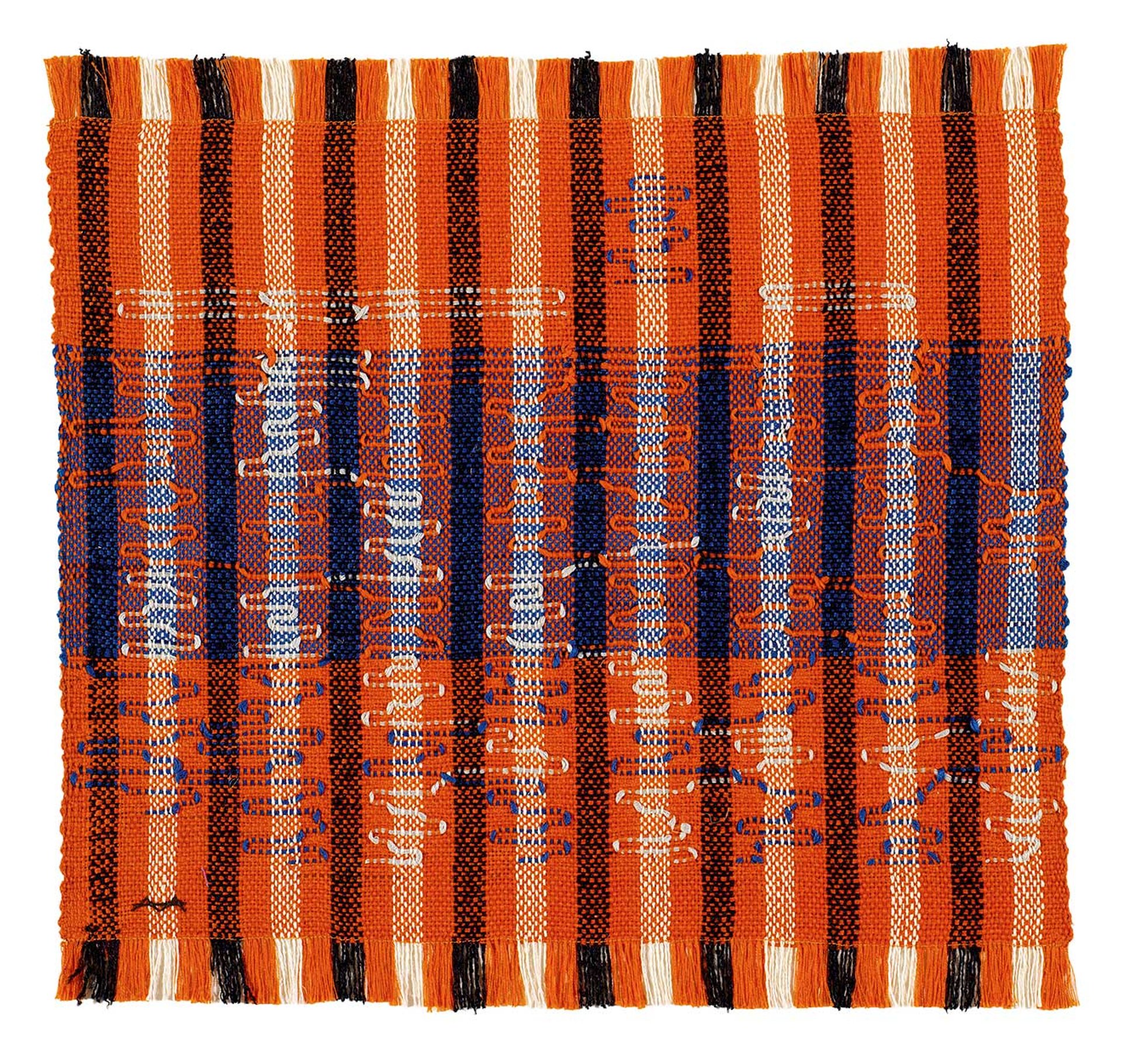
Albers’s cotton-and-rayon woven work Intersecting (1962), displaying her signature grid motif © Josef & Anni Albers Foundation/ARS, New York
Hardly. As we follow Weber’s absorbing account of Anni’s life—from her childhood in Berlin to her Bauhaus years to North Carolina’s Black Mountain College to Yale University, where Josef became a professor in 1948—one gets a distinct sense of her fierce determination, her willingness to challenge established meanings of art. Anni had no qualms about seeing her products, like the cotton bedspreads she designed in 1949 for the dorms at the Harvard Graduate Center, produced by machines. (Later in her career, she enthusiastically embraced the opportunities afforded by offset printing). But she also insisted that her creations were genuine works of art, the direct result of her hand guiding the designs, inserting individuality into sameness, improvisation into predictability. Taking something that we would expect to find under our feet, and putting it, reimagined and transformed, on the wall for our contemplation blends, function and beauty, changing the way we see both.
Deviations in uniformity
One might productively understand Anni’s oeuvre as expanding and complicating the advice given by her mentor Paul Klee to “take a line for a walk”. In her early work, she still revelled in rectangles and grids: the cotton-and-silk Black-White-Gray (1927/1964, Museum of Modern Art) consists of 15 horizontal rows of rectangular boxes in black, dark grey and white. The closer one looks, however, the more these shapes begin to wobble and dance. Anni’s design makes us appreciate the deviations hidden in uniformity, the nuances of outlines that look alike only to the casual viewer.
In her subsequent work, she moved to liberate those lines. Black-White-Gold I (1950, cotton, lurex, and jute, Josef & Anni Albers Foundation) presents loops of white and black superimposed, as if in a circuit diagram, upon a multi-hued background. And in Intersecting (1962, cotton and rayon, Josef Albers Museum), squirrelly lines of black and white compete with the strong vertical bands of red, white, and black behind them. Here Anni is no longer taking lines for a walk but for a run. It is hard not to glimpse in such weavings some of the “subjectiveness” Anni disdained, or not to take her creations as a veiled commentary on a time ruled by standardisation and uniformity of purpose. Showing how patterns fail, how difference prevails over sameness, can be a political statement, too.
Informative, not impartial
Anni Albers: A Life is a substantial achievement: extravagantly detailed, well-illustrated and informative in the readings of Anni’s art it contains. Weber, to be sure, is not an impartial witness; he devotes, in my view, far too many pages to the nefarious doings of the Swiss-Austrian actor Maximilian Schell, who pushed himself into the elderly Anni’s life. And a few readers might find themselves wishing for more writerly restraint—Weber has an irrepressible fondness for the verb “relish”, for example, and for syntactic headscratchers such as: “Klee’s train pulled into Weimar so that he could take up his teaching position.”
One might wonder, finally, if Anni would have liked seeing reports of her personal quirks placed right alongside discussions of her artistic accomplishments. But this reviewer at least was grateful to learn about her recipe for “gourmet” chocolate cake, marked by the same rebellious orneriness one finds in her textiles, too: crush a package of Oreos, mix the broken cookies with Cool Whip (“a marvellous product that is like whipped cream already made for you”), place the whole thing in the freezer for three hours. Enjoy.
- Nicholas Fox Weber, Anni Albers: A Life, Yale, 408pp, 64 colour + 25 b/w illustrations, £25 (hb), published 21 July
- Christoph Irmscher is a critic and biographer