Gertrud Müller was orphaned very young, but she still managed to buy a Van Gogh portrait at the age of just 19. This was before the artist had won international recognition—and she was among the very earliest Swiss collectors of his work.
The painting was dispatched to Müller on 27 April 1908, two days before her 20th birthday and paid for the following day (30 April). She eventually bequeathed the Van Gogh to the Kunstmuseum Solothurn, in her hometown in northwest Switzerland. This week it went on loan to the Kunstmuseum Basel, for their exhibition Van Gogh, Hodler, and a Cabriolet: The Collector and Pioneer Gertrud Dübi-Müller (until 7 February 2027).
Born in 1888, Müller led a bold life for a woman of her time. At 19, she had travelled with her brother to Algeria and Tunisia. Aged 23, she was the first woman in Solothurn to buy a car, a cabriolet (convertible) Piccard-Pictet, known as a Pic-Pic. She soon became a skilled photographer, specialising in vertiginous Alpine landscapes. At 49, Müller climbed the Matterhorn.
But above all, she was a pioneer in collecting modern art. The Van Gogh portrait was her very first purchase.
Both of Müller’s parents died when she was very young—her mother one month after her birth (of a postnatal infection) and her father when she was aged six. She was financially cushioned, however, by inheriting their wealth, derived from the family’s engineering company.

Van Gogh’s Portrait of Charles-Elzéard Trabuc (September 1889)
Kunstmuseum Solothurn, Dübi-Müller Foundation
To acquire Van Gogh’s Portrait of Charles-Elzéard Trabuc (September 1889), she had to wait until her 20th birthday so that she was “of age”, and could therefore spend some of her inheritance.
Müller had been exposed to art at an early age. At 14, she got to know two major Swiss artists, Cuno Amiet and Ferdinand Hodler. Two years later, Amiet gave her painting lessons and introduced her to the work of Van Gogh. Müller also met Giovanni Giacometti (the father of Alberto Giacometti, who would have been a young child at the time). She was therefore in close touch with three of Switzerland’s leading avant-garde artists.
Müller saw her first Van Gogh exhibition in March 1908 at Galerien Thannhauser in Munich. It was just a month later that she bought Portrait of Charles-Elzéard Trabuc from Vienna’s Galerie Miethke, which was then run by another of her friends, the artist Carl Moll.
Buying this particular Van Gogh was an astonishing choice for a young woman. The painting had long been titled as a portrait of a hospital orderly (without the sitter’s name), so Müller must have known that it dated from his period in an asylum. Van Gogh was then widely dismissed as “mad”, so few collectors would have been bold enough to buy a portrait of the orderly who cared for the artist.
Müller paid 40,000 Swiss francs, then equivalent to $7700. This was a substantial sum for a modern painting at the time.
Géraldine Meyer, the curator of the Basel exhibition, says that this purchase “set her circle of friends on fire”. Amiet and Giacometti even coined a German verb for their enthusiasm which was inspired by Müller’s acquisition: van gogheln—they went “Van Goghing”.
Giacometti was very keen to see the Van Gogh. Later that year, Müller drove it over 300km to his home in Stampa, a village on the other side of the Alps. He immediately painted a portrait of a local farmer, Giovanin de Vöja, which was directly inspired by the Van Gogh (this picture is now at the Bündner Kunstmuseum Chur in eastern Switzerland).
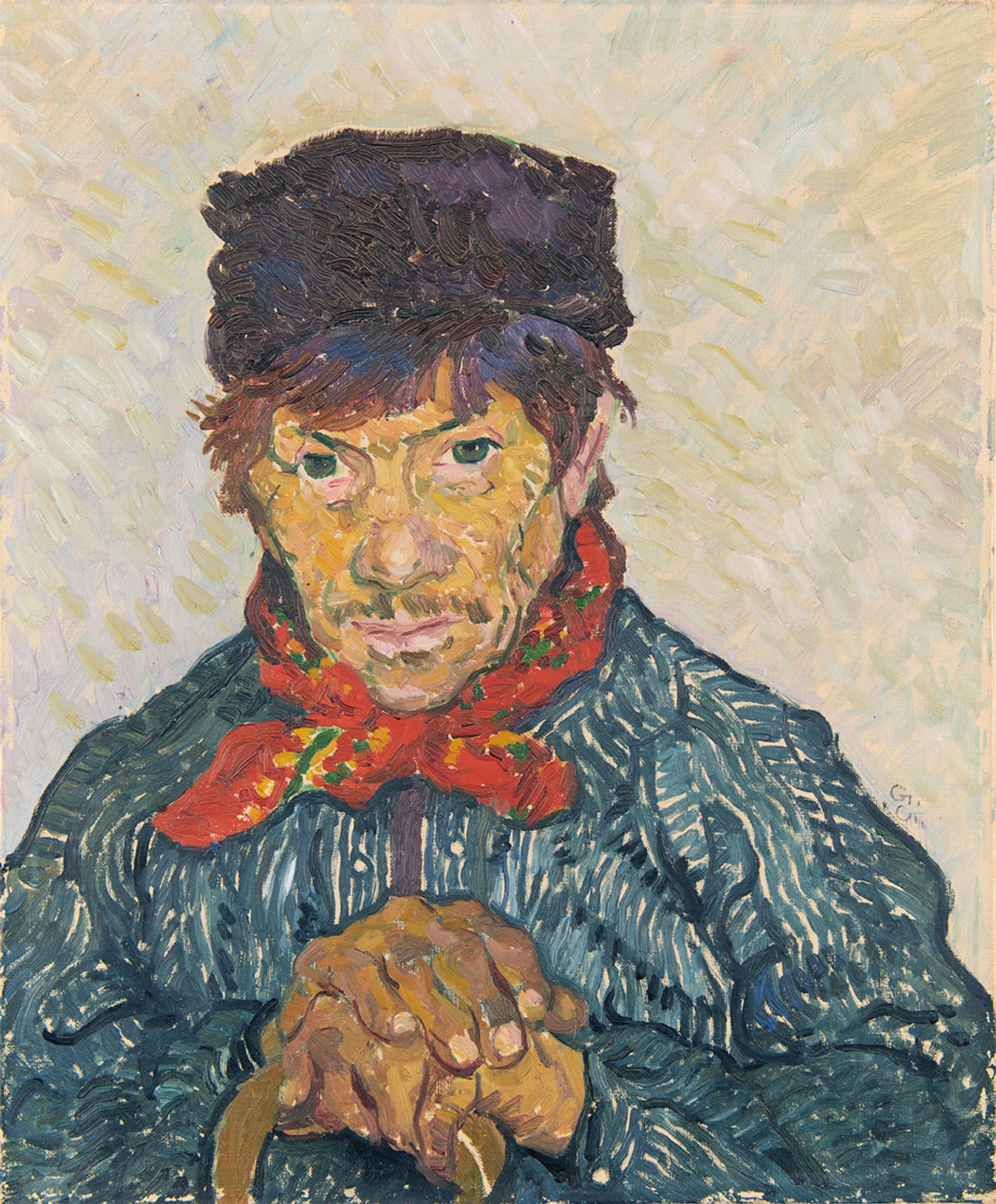
Giovanni Giacometti’s Portrait of Giovanin de Vöj (around 1908)
Bündner Kunstmuseum Chur
The following year, she lent the Van Gogh portrait to Amiet, who hung it in pride of place in his studio in Oschwand, near Solothurn.
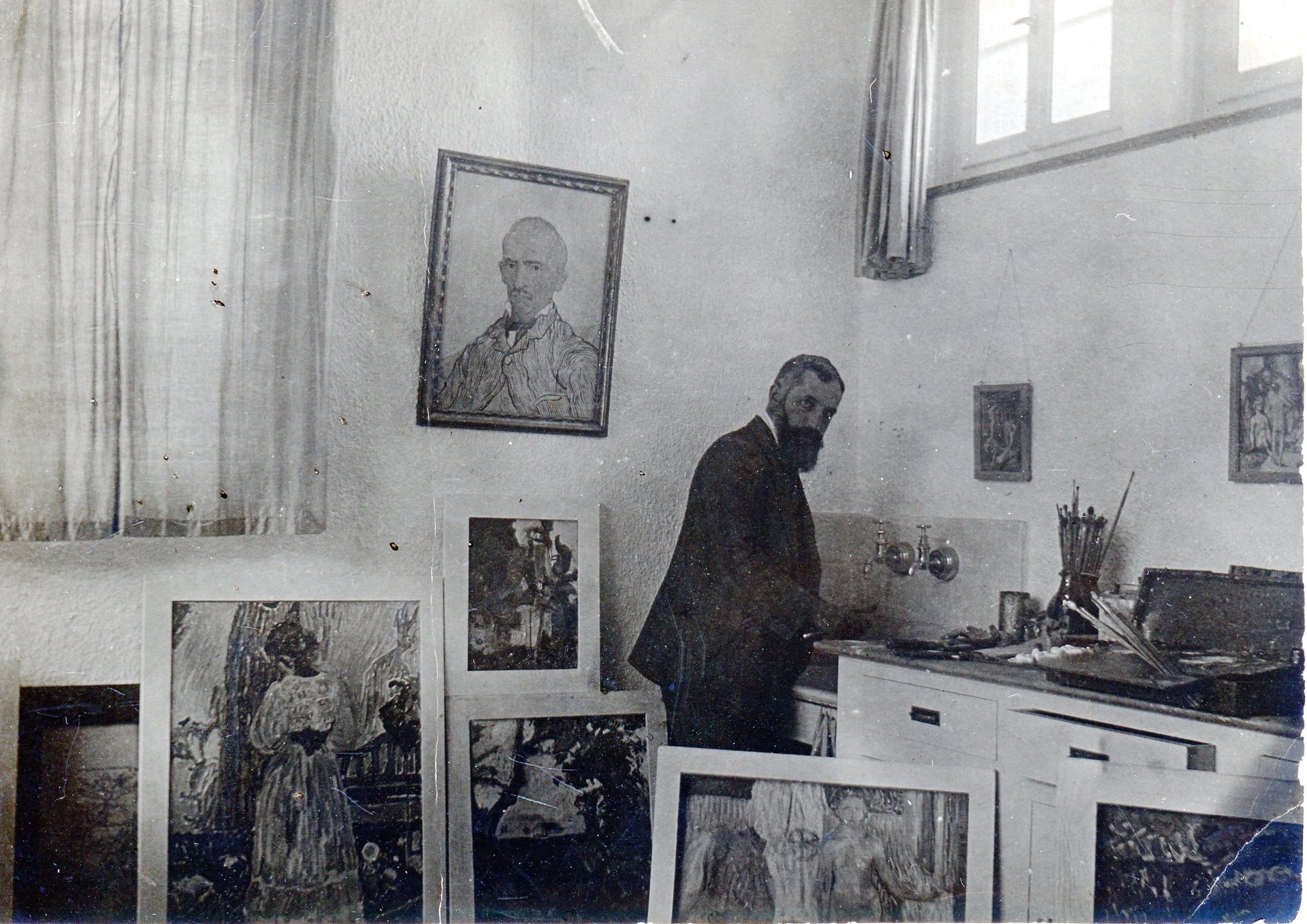
Cuno Amiet in his studio in Oschwand, with the loaned Van Gogh portrait (1909-10)
Amiet Archive, Fondation Cuno Amiet, Aarau, Switzerland
Four years after the purchase, Müller drove in her Pic-Pic to Saint-Rémy-de-Provence to visit the asylum. There she met Sister Epiphane, who had been there in Van Gogh’s time and had become the mother superior. The Sister confirmed that the portrait depicted the head orderly. But it was not until 1959 that Müller discovered his name: Charles-Elzéard Trabuc.
Portraying Trabuc
Van Gogh had painted the portrait at the beginning of September 1889, just two weeks after he had recovered from a month-long mental crisis. The artist must have been grateful for the care he had received from Trabuc and his staff.
The first version of the portrait was given to Trabuc, but was sadly lost, probably well over a century ago. Vincent also made a copy of it, which he sent to his brother Theo; this is the version which Theo’s widow Jo Bonger sold in 1908 and it quickly went through a dealer to Müller.
Vincent wrote about the portrait to his brother, explaining that Trabuc had cared for victims during two cholera epidemics: “He’s a man who has seen an enormous number of people die and suffer, and there’s an indefinable contemplation in his face… He’s a man of the people.” A few days later Vincent wrote that “he has something military about him, and dark eyes that are small and lively”.
Van Gogh also painted a companion portrait of Trabuc’s wife Jean. As Vincent explained to Theo: “I spoke with her from time to time when I was doing [painting] olive trees behind their little farmhouse, and then she told me that she didn’t think that I was ill—anyway, you would say that too at present if you saw me working, with my thoughts clear and my fingers so sure.”
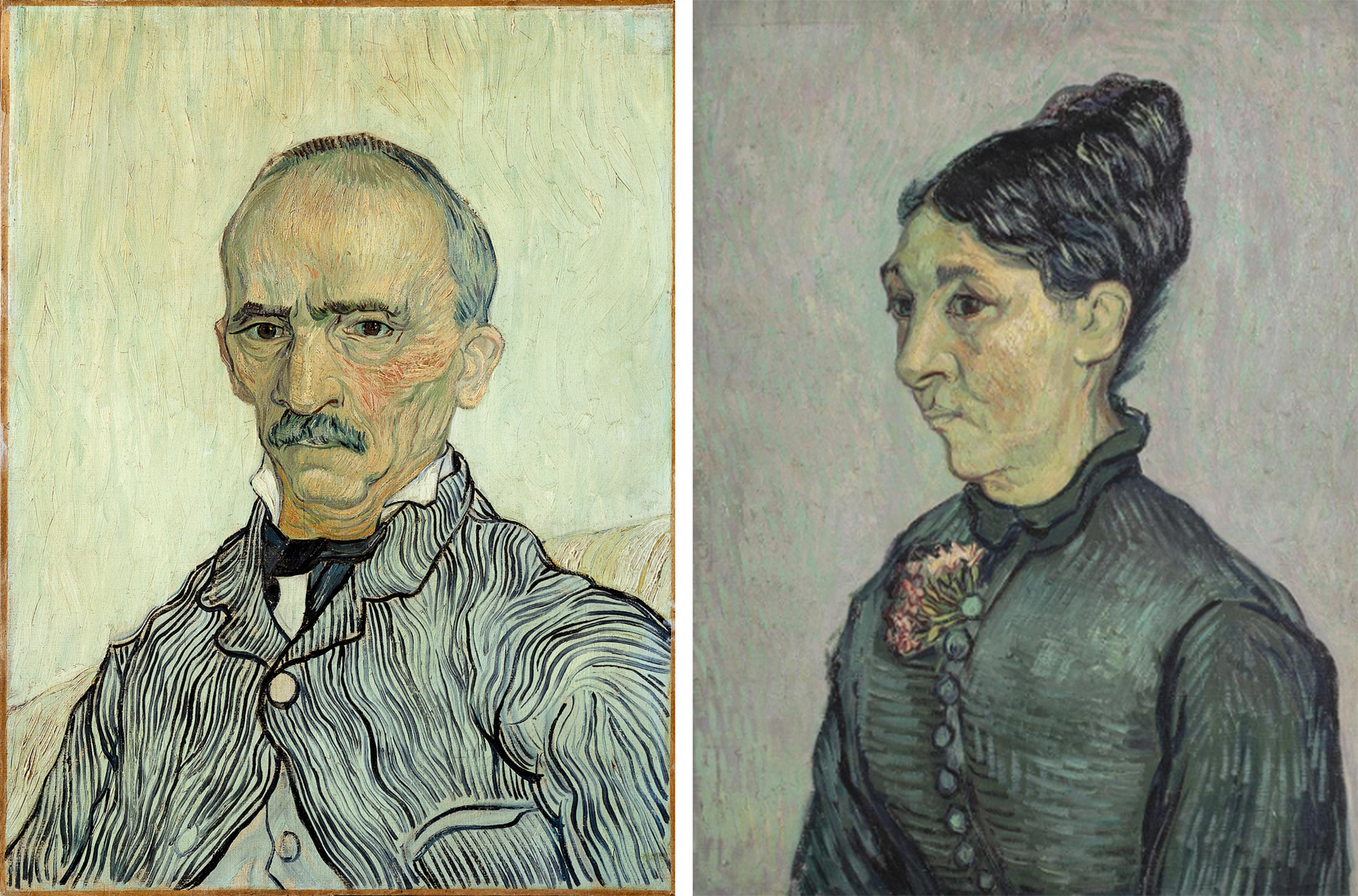
Van Gogh’s Portrait of Charles-Elzéard Trabuc (September 1889) and Portrait of Jean Trabuc (September 1889)
Kunstmuseum Solothurn (Dübi-Müller Foundation) and State Hermitage Museum, St Petersburg
He described the resulting portrait of the orderly’s wife: “Face faded and tired, pockmarked, an olive-tinged, suntanned complexion, black hair. A faded black dress adorned with a soft pink geranium, and the background in a neutral tone between pink and green.”
The two portraits were later separated by Bonger. Monsieur Trabuc went to Müller in 1908, and Madame Trabuc was sold to the German collector Otto Krebs in 1927. In 1945, at the end of the war, the Krebs painting was looted by the Red Army and is now at the State Hermitage Museum in St. Petersburg. The portrait of Jean will almost certainly never leave Russia—and the Trabuc couple will likely remain apart.
Müller's twin portraits
Müller was herself portrayed by Amiet and Giacometti. Both painted her on the same occasion in 1907, a year before she bought the Van Gogh portrait. The prominent brush strokes of the two Swiss artists is reminiscent of Van Gogh’s style.
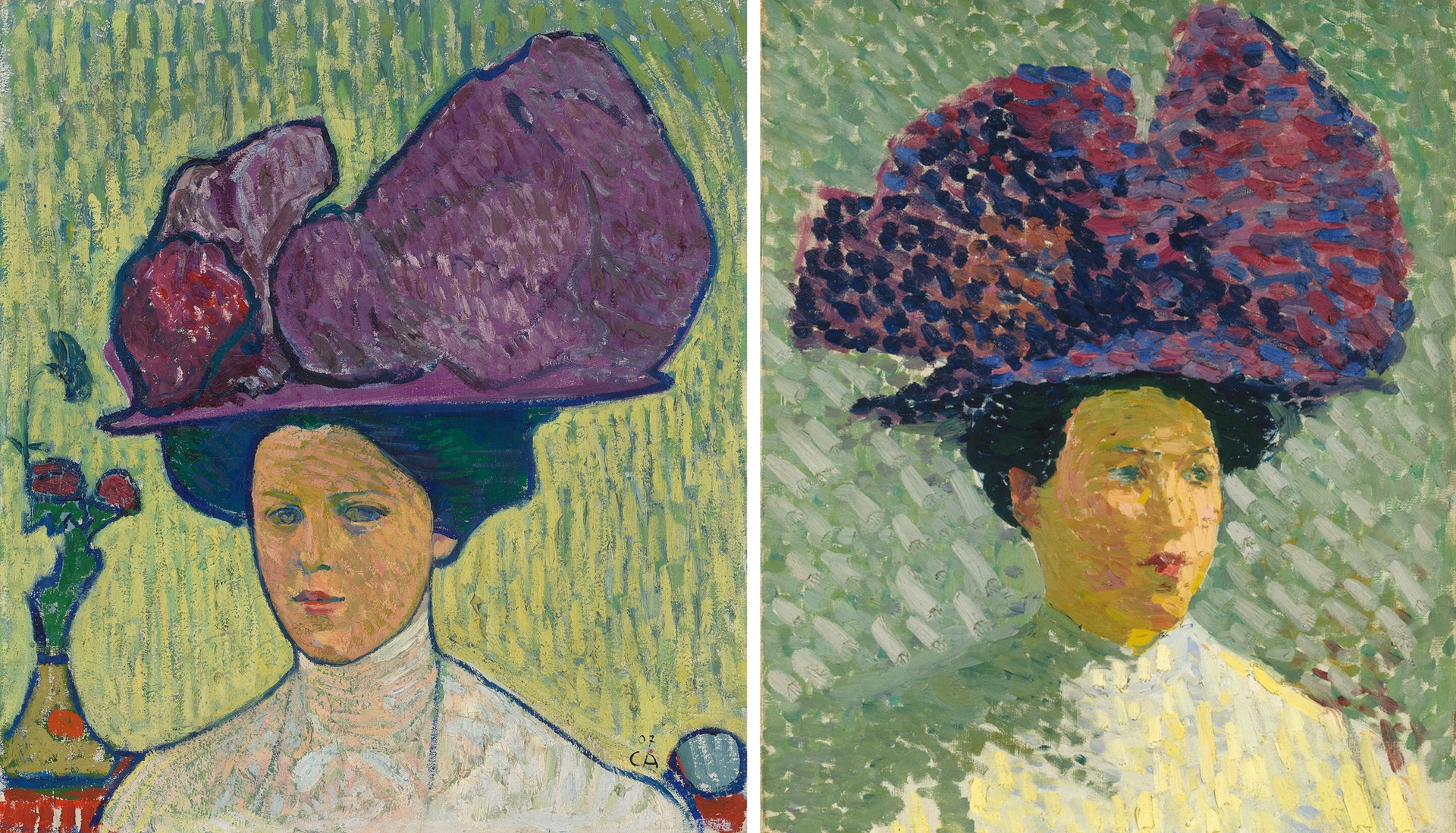
Cuno Amiet’s The Violet Hat (Portrait of Gertrud Müller) (1907) and Giovanni Giacometti’s Portrait of Trutti [Gertrud] Müller (1907)
Kunstmuseum Solothurn (Dübi-Müller Foundation) (photograph SIK-ISEA Zürich, Martin Stollenwerk) and private collection (photograph SIK-ISEA Zürich)
Painting the portraits alongside each other, Amiet and Giacometti were consciously following in the footsteps of their heroes, Van Gogh and Gauguin. In November 1888, the two Post-Impressionists had portrayed Marie Ginoux, who helped run the Café de la Gare in Arles. On that occasion, they worked side by side, painting her in her Arlesienne costume.
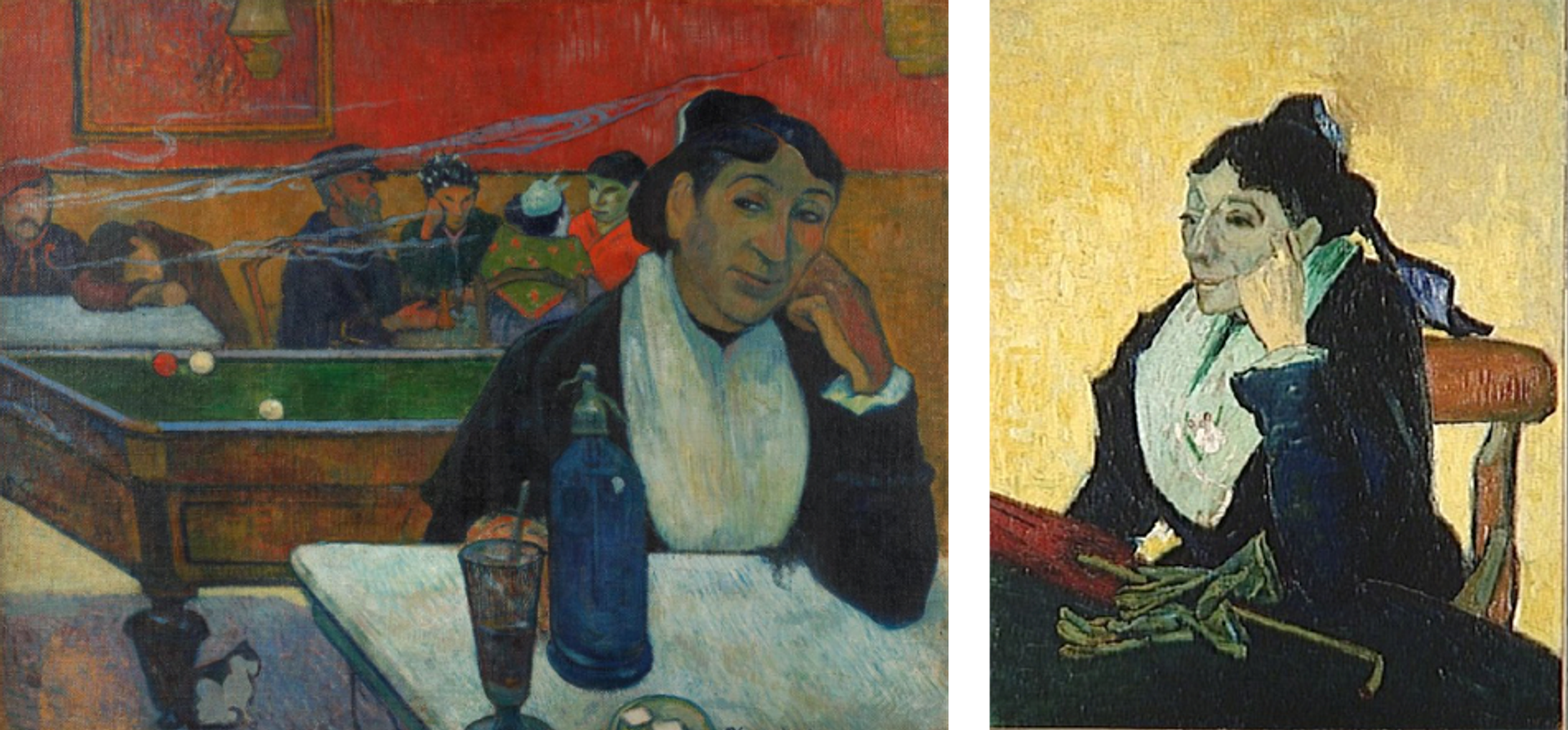
Paul Gauguin’s Café at Arles (November 1888) and Van Gogh’s Arlésienne (November 1888)
Pushkin Museum of Fine Arts, Moscow and Musée d’Orsay, Paris
In 1921, Müller, then aged 33, married Otto Dübi, a lawyer (she then took the surname Dübi-Müller). The couple continued living in Solothurn and the Van Gogh was hung in their small salon, opposite a Louis XV armchair, where she would read and embroider. Her niece, Monique Barbier-Mueller later recalled that Trabuc's stern face caught every visitor's eye. Müller would end up enjoying the painting for nearly 72 years.
Müller died in 1980, bequeathing 190 works to the Kunstmuseum Solothurn. Along with the Van Gogh, the bequest included paintings by Paul Cezanne, Henri Matisse, Gustav Klimt and Pablo Picasso, along with those by her friends Amiet, Hodler and Giacometti.
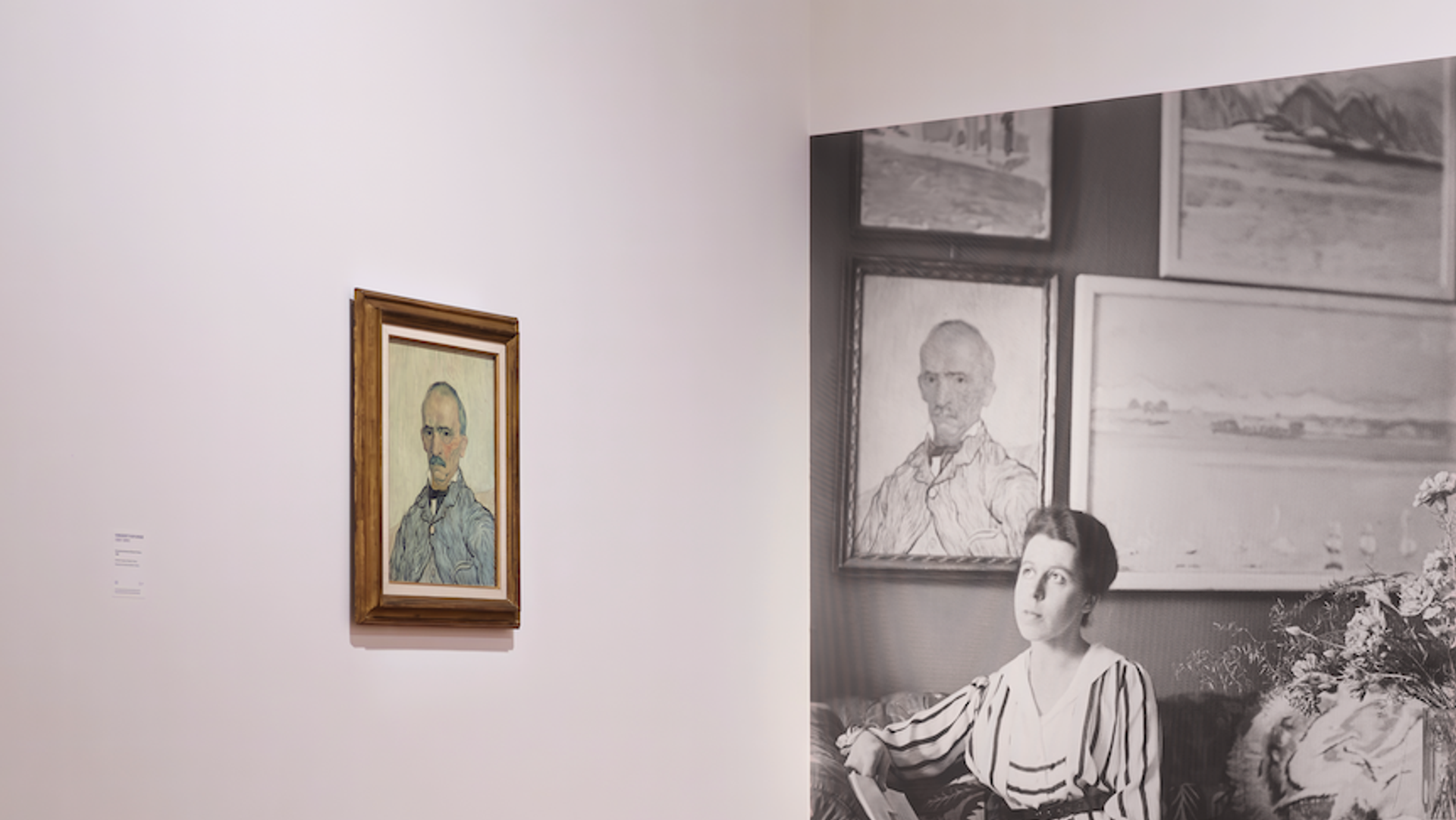
Van Gogh’s Portrait of Charles-Elzéard Trabuc and an enlarged photograph of Müller with the painting in her home, installed in the Kunstmuseum Basel exhibition (until 7 February 2027)
Kunstmuseum Solothurn, Dübi-Müller-Stiftung (photograph Samuel Bramley)