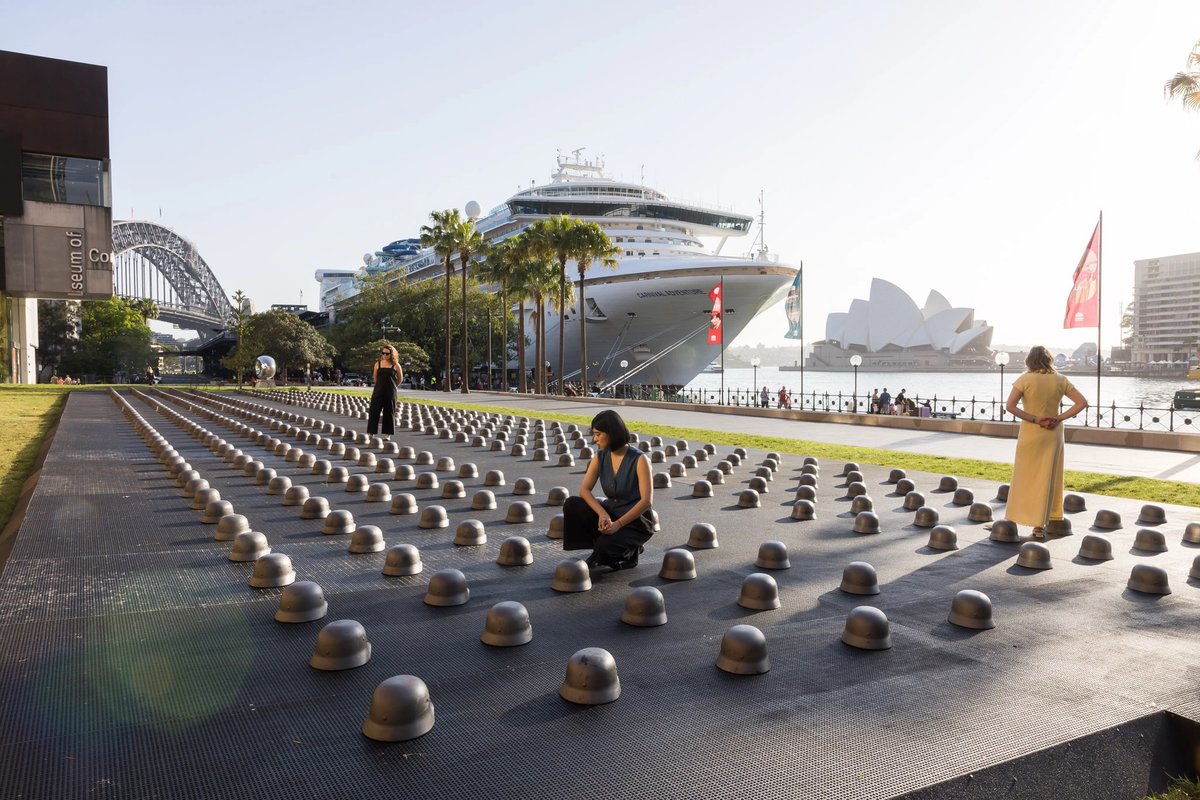
Ai Weiwei’s latest work is “a metaphor and a warning” of how quickly humanity could slip into an epoch of darkness, the Chinese contemporary artist tells The Art Newspaper. The work, titled Mushrooms, comprises 500 cast-iron combat helmets in ten uniform rows. According to a statement from the artist, the fungal title refers to “growth in darkness, nuclear mushroom clouds, and in Chinese, the term also suggests endless delays”.
Mushrooms was unveiled on Friday 25 September as the new Neil Balnaves Tallawoladah Lawn Commission outside Sydney’s Museum of Contemporary Art Australia, and will remain on view for seven months. The commission is named after the Australian philanthropist and businessman Neil Balnaves, who was 77 when he died in a boating accident near Tahiti in 2022.
Ai says his idea for Mushrooms originated when Germany offered 5,000 helmets to aid Ukraine just before the country was attacked by Russia in February 2022. Germany’s response to the looming humanitarian disaster was internationally condemned as laughably feeble.
Mushrooms, however, is “not a political joke”, Ai tells The Art Newspaper. “Rather, it demonstrates how shallow an understanding today’s national leadership can have of the human condition and of what may happen in the future.”
He adds: “The history of civilisation spans only a few thousand years, during which humanity has not yet developed a solid understanding of the value of human beings, nor established sufficient constraints on the political actions of states, regimes or interest groups.
“In fact, we remain in a state of uncertainty, one in which the foundations themselves seem increasingly vulnerable to being overturned. What we call civilisation today, or the sense of security to which we have become accustomed, can disappear within a very short space of time.”
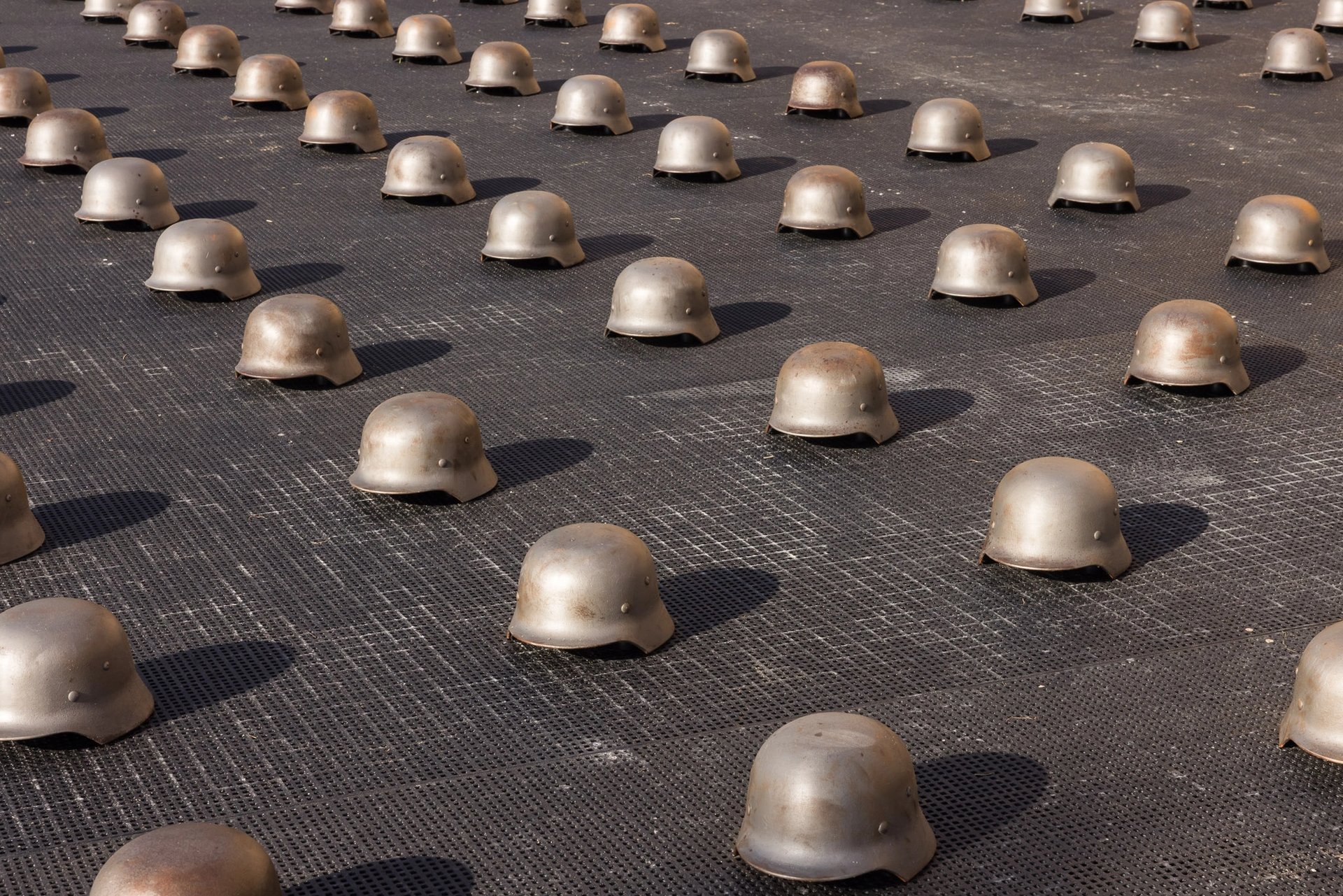
A closer view of Mushrooms
Image Courtesy Ai Weiwei Studio, MCA Australia, Galleria Continua and Lisson Gallery ©Ai Weiwei Studio; Photography: Anna Kučera
Sense of uncertainty
Ai says that although the present era seems full of possibility, he has never more felt that humanity as a whole has faced such a profound sense of uncertainty about the future as it does now.
“This uncertainty does not arise merely from the rapid development of society, technology and productive capacity; at the same time, it comes from humanity’s deep immersion in the simple pursuit of material gratification, and from our gradual loss of reflection on the value of life itself.”
Not only wars, but the rapid development of artificial intelligence, is “challenging many of humanity’s existing systems of values”, the artist says. “These value systems encompass questions of trust and belief, as well as the increasingly distant and antagonistic relationship between individuals and society.”
Ai says he continues to be inspired by his late father, the famous poet Ai Qing. Ai Qing’s instinct for truth and freedom of expression earned him a life of unimaginable hardships in China under Mao Zedong. Ai Weiwei’s 2021 book, 1000 Years of Joys and Sorrows: A Memoir, detailed Ai Qing’s hard but inspiring life.
Ai Weiwei said the ability to speak out on human rights and freedom of expression is “the final form of resistance still available to humanity”, which is the thinking behind Mushrooms.
The first commission was last year, when British sculptor Thomas J. Price created Ancient Feelings, a three-metre high golden bronze sculpture of a woman’s head gazing towards Sydney Harbour.