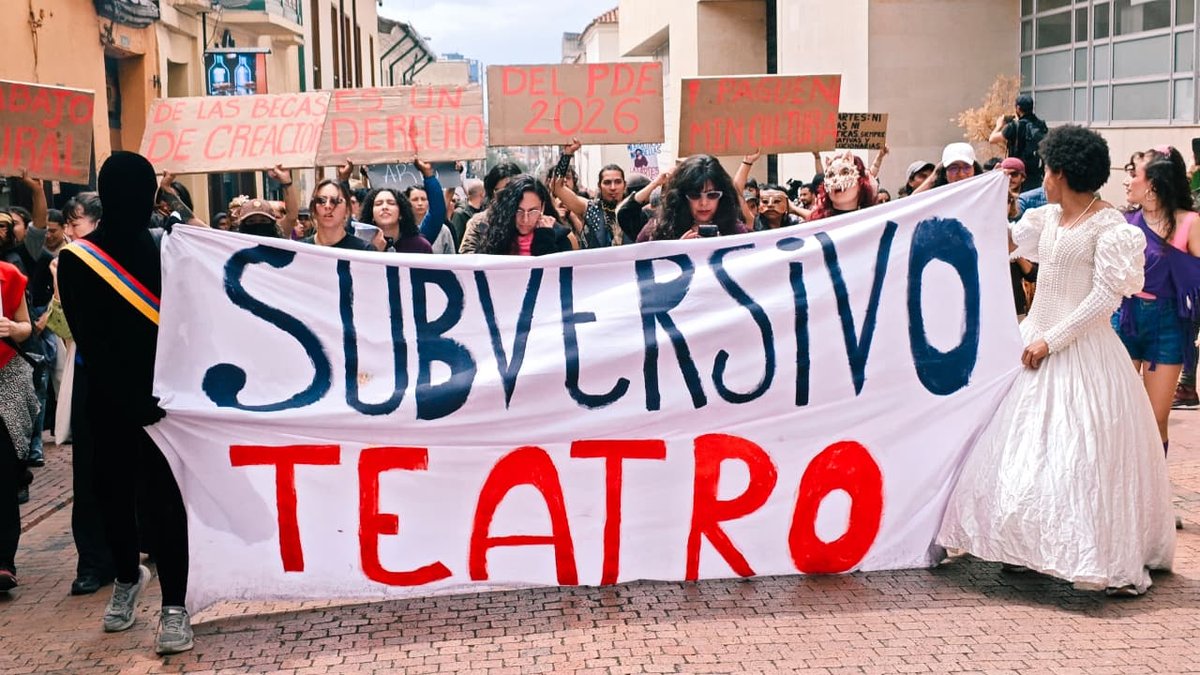
Hundreds of artists, students and cultural workers gathered outside of Colombia’s Ministry of Culture in Bogotá on Monday (21 September), protesting a proposed 30% cut to the cultural budget in 2027 and a suspension of national arts awards.
“The previous government says the funding was there, while the current government says it inherited debt, not funds,” Dubán Prado, the director of the independent theatre group Subversivo Teatro, tells The Art Newspaper. “So artists are caught in the middle of a political dispute and end up paying the price. The cultural sector should be the last to suffer because of this.”
The 2027 budget proposal presented by Colombian president Abelardo de la Espriella’s government would cut $90m from the cultural ministry’s budget, even as the overall national budget is set to increase by 14.2%.
Days after the cuts were announced, the ministry suspended—for the first time in 27 years—the evaluation and selection of winners for the national prizes and recognitions categories of the Programa Nacional de Estímulos. The decision was announced the day before the winners were due to be announced. This left 1,308 eligible applications without evaluation: 351 for national prizes and 957 for recognitions.
“The current government inherited a serious fiscal crisis caused by the [Gustavo] Petro administration,” the ministry said in a statement published on 19 September, blaming Colombia’s previous president for creating a need for severe cutbacks. It stressed that the national arts awards programme itself had not been suspended: the decision applies only to two categories and only for 2026. The ministry said it lacked the roughly $270,000 to pay jury members and $2.75m to fund the awards.
The previous administration said it had already secured the funds in the budget, while the current ministry argues that there was not enough cash available to make the payments.
The organisations behind this week's protest are calling for the decisions to be reversed, outstanding payments to be made, funding for the sector to be guaranteed, and a formal dialogue with the ministries of culture and labour on issues, including working conditions for artists and cultural workers. Delayed payments were a focus of the protest. The government itself admitted that the debt is affecting 4,162 beneficiaries across various cultural programmes.
Lili Bonil, the president of the Alianza Nacional de Trabajadores Audiovisuales, argues that the impact goes beyond the suspended awards. “The effects of decisions that disrupt the country’s cultural sector are now being felt by thousands of arts workers,” she says. “The content, spaces and structures that have taken years of work and thought to build and sustain are being weakened by a discourse that treats culture as an accessory.”
Prado says that his theatre company received a payment this week, after nearly three months of delays, under a separate programme supporting cultural spaces for arts education. “The mobilisation worked, after formal requests, complaints, claims and more,” he says.
After the protest, Colombia's culture minister, Paola Holguín, posted a video on social media in which she stressed that the suspension would apply only to 2026, linking the decision to financial problems inherited from the previous government. “It is better to tell the truth than to keep misleading such an important sector: artists, cultural managers and creators,” she said.