Both an investigator and an artist, Lawrence Abu Hamdan is known for his work that probes cases of environmental and human rights abuse using sound. Over four days this month, the Turner Prize-winner will lead Repercussions, the first cross-arts takeover of its kind at the Barbican Centre in London, spanning the organisation’s visual art, film, music and performance programmes.
In 2023 Hamdan, who was born in Amman and is based in London, founded Earshot, a non-profit that builds on his own work using audio forensic analysis techniques within the field of human rights research. Earshot is unique in its treatment of sound as an input in this context, but its output is deliberately unconstrained: “We write reports, we produce video games, we do whatever is necessary for the urgency of those stories to emerge in global media, in advocacy campaigns, with lawyers, with courts on the ground,” Hamdan says.
Among other things, the Barbican takeover includes a screening of Rififi (1955), a French film featuring a 30-minute silent burglary sequence; a two-day audio analysis workshop; and Zifzafa, an exhibition by Hamdan that includes a video game exploring sonic disruption and resistance in the Israeli-occupied Syrian Golan Heights. Such a wide remit is fitting for an artist whose own chosen medium and format shift is in response to the unique requirements of communicating about each case that he works on.

The Zifzafa exhibition pictured when it was at the Munch museum in Oslo in 2024 © Lawrence Abu Hamdan; courtesy of Munch museum
The Art Newspaper: How did you approach a project as broad in scope and media as Repercussions?
Lawrence Abu Hamdan: It was a chance to open up parts of long-term research projects that never saw the light of day; to invite artists into Earshot’s archive and for their perspectives to change the way that we hear those sounds.
After three years of Earshot, we’ve got sounds from all over the world. People send us investigations from everywhere, from Honduras to Tanzania to Gaza. This was a chance to show how rich and diverse those sounds are and where the interrelations are—how sound resounds through struggles for global liberation.
Is there a thematic thread running through it?
We had this idea of exploring the sonics of self-
determination, asking how sound is a core part of the formation of community and political struggle. That’s a question I’ve been personally invested in throughout my career, but it was important to open that up to others and think about it through other mediums and material.
It’s not really curating. I have too much respect for curators to call myself something like that. It may seem like a hodgepodge of things. But, if you think about the way that I’ve been training myself to listen over the years, I’ve been invited into and guided through political struggles all over the world, and they create this debris of sounds: the residue of sonic weapons here, gunshots there, a hydraulic door breacher there. It’s a strange collection of objects that you might not associate with one another in a visual sense, but [they] collide together through the sonic investigations that we’ve been doing. I’ve tried to capture some of that energy in the spirit of the takeover.
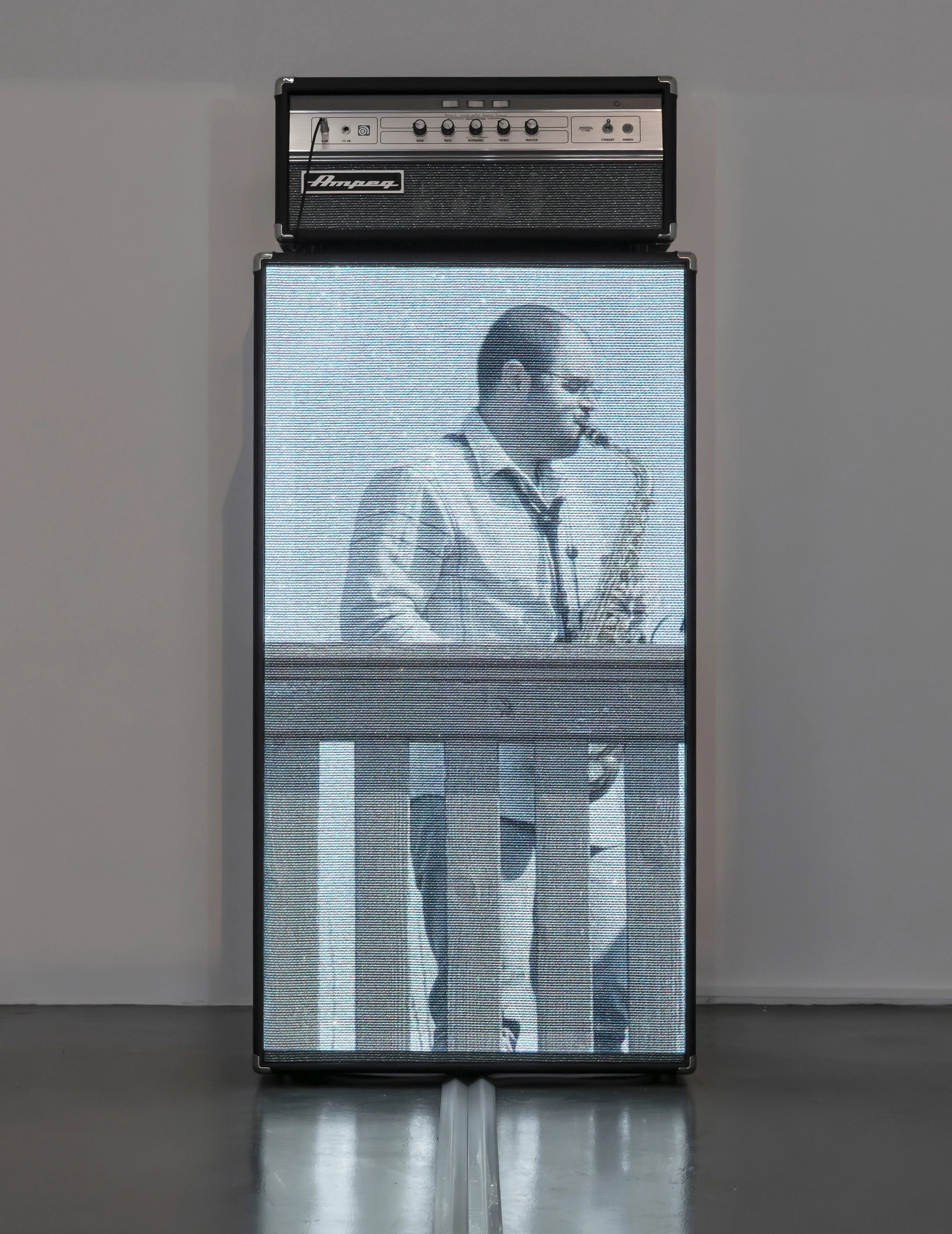
Wind Ensemble (2024), which was part of Zifzafa, includes a saxophone performance by Amr Mdah Photo: Hafid Lhachmi
How did you find the process of working with so many different mediums?
I like to think about technology in a nonlinear way. Tomahawk and Patriot missiles are being used today [in wars], but so too are hammers. I like to think about how we can think about the sounds that have trained our political ear in a similar way: how do we deploy a silent movie from the 1950s alongside something like Machine Listening, a group from Australia who are on the cutting edge of exploring synthetic audio?
Before the performance of a new work, 450XL: A silent movie, you will give a lecture titled Listening to Punks. Have punk aesthetics and the DIY music scene—which you were once part of—contributed to your work?
It’s less aesthetic, more ethics. I think one of the most beautiful things about the DIY scene is how inclusive it was aesthetically. It allowed for hardcore crusty punk bands together with free jazz and experimental noise. It was aesthetically inclusive but politically had its own form of socialisation that was relatively strict and was anticapitalist. Being involved in that informed how I think about my relationship to audiences. It was really where I first encountered what sound does in the formation of community. The lecture picks up on that; it talks about how my journey with forensic listening began in the unexpected place that you identify.
Running throughout the takeover will be Zifzafa, an exhibition involving a body of work that was previously shown at the Munch museum in Oslo and will also be shown this year at The Common Guild in Glasgow. Can you describe it?
The body of work is part of our research contending with the construction of 31 of the largest land-based wind turbines that are being built in the last piece of open space available for the Jawlani Syrians living under Israeli military occupation [in the Golan Heights]. In 1967, 95% of that land was taken from them. Of the remaining 5%, a quarter of it will now be bathed in an uninhabitable noise generated by these massive turbines.
They’re not yet constructed, so we built a video game that accurately simulated the vast amounts of noise pollution, using recordings from sites where these turbines exist in Germany. We made it so that lawyers and stakeholders could show the courts how much damage this would do to life and community in the region, but also as a tool to preserve the existing sounds and archive them should these turbines be built in the future. We’re not only looking at the noise pollution but also the rich and vibrant sonic community that we’re losing. The piece celebrates that too.
For the installation, Zifzafa (2025), I used maybe the most popular moving image medium in the world, which is watching other people play video games. We do a kind of sonic take on the video game walkthrough format. We walk through the digital landscape and explore the sounds that have been recorded and placed in that digital terrain.
The second work, Wind Ensemble (2024), is a performance by a saxophonist called Amr Mdah, recorded on the roof of a house that will be, in the future, just 50m away from those turbines. The saxophone is his own wind instrument, and he is performing this kind of exuberant act of sonic self-determination that I hope will resonate through the whole four days.
How do you manage the production of an exhibition with so many different disciplines and practitioners?
Sound is often very abstract for people to understand. How can we, as Earshot, translate it and offer a way of understanding it as a site for political struggle? That’s really our main mandate. First of all, we conduct the research. Then we think about what’s the most effective way to disseminate that research.
The space and time afforded to us by cultural institutions allows us another temporality, away from the urgency of moving from case to case in a dizzying fashion, and allows these things to breathe. It allows us to unfold those sounds in a way that is perhaps lost in the speed and urgency of news reports, or the two minutes we have to speak about a case on [the independent news programme] Democracy Now!, for example.
For me, it’s as much a question of experimentation with how to tell those stories as it is to give some of these cases the time that they deserve.
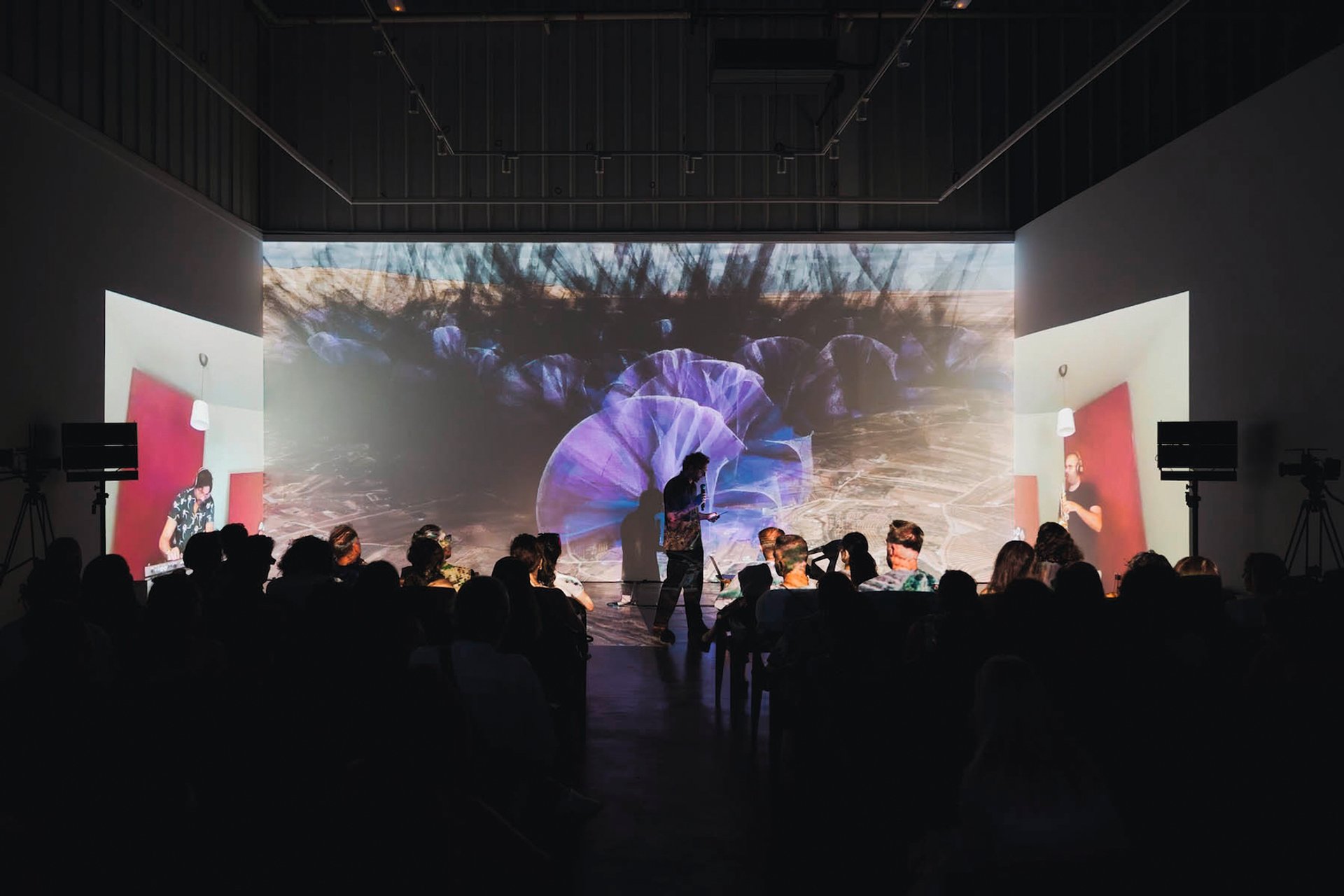
Zifzafa includes a live audio essay and what Hamdan calls a “sonic take on the video walkthrough format”. The work explores the audio impact that giant wind turbines would have on residents of the Golan Heights Photo: Kristina Sergeeva
You have said that you are not particularly interested in studying the boundary between your work as an artist and your work within Earshot. Hearing about its mandate and methodology, it sounds like they are two inextricable ways of disseminating the same core information.
The people who never ask me those questions are the people on the ground and the people we work with. For them, it makes perfect sense. Anybody working in such struggles understands the necessity of changing laws. To change laws often involves changing culture, right?
The only people who ask me those questions are the art press. Those boundaries may be important to make for the culture industry, but they’re not important for practitioners and people in the world.
• Lawrence Abu Hamdan: Repercussions, Barbican, London, 23-26 September